Aug 11, 2006

Blue budgie found in back garden


When I spotted three dead animals on my way to work yesterday it felt like an omen.

I rode my bike along the usual route, but I saw a dead mouse in the gutter on the corner. Next I passed a flattened pigeon. Then I found a mauled and bloodied sparrow.

It's not unusual to pass a dead squirrel on the road in the fall or a dead bird throughout the summer months, but never have I seen three dead animals in a row.

Tonight I was eating supper with my parents in the back garden when a blue budgie landed on the birdbath alongside some sparrows.


At first I thought it was fantastic that the budgie was free, but then realized there are many threats out of doors for a tame bird.

I telephoned the Toronto Humane Society and was told to call animal control. The Humane Society also suggested I post a "found" ad on their Website, which I did.

Animal control said to call back in the morning if the budgie were still there, which of course it was not.

My father found a cage I had turned into a prop for a Fringe Festival play and suspended it from a hook near the cedar tree where the bird was roosting. He left its door open so the budgie could fly inside for safety.

My mother remembered that when she was a girl she and her brother John had two budgies that lived by the grandfather clock in her cottage in the English village where she grew up. One day she came home and the budgies were gone.

She thinks her mother gave them away because they were so messy.

My parents reported no further sightings of the blue budgie the following day, but left the cage out just in case it returns ~

Aug 8, 2006

AIDS rally champions rights of women


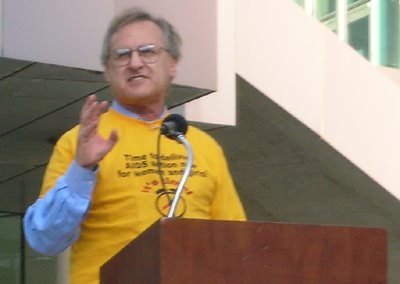
About 600 people, many of them wearing canary-yellow T-shirts with the slogan “Time to Deliver” printed on the front, rallied outside Toronto’s Metro Hall on Monday to protest the plight of women infected with HIV/AIDS.

Organizers held the rally in conjunction with the 16th International AIDS Conference to demand action against the spread of the disease among women and girls. The focus of the conference is on unfulfilled promises made by governments that would help make AIDS treatments available worldwide.

The rally echoed the theme of the conference, but with a feminist twist.

More than 20 million people have died from the disease in the 25 years since the U.S. Centers for disease Control and Prevention reported the first cases in 1981.

“This pandemic is being driven by gender inequality, and the only thing more intractable than the virus itself is gender inequality,” said speaker Stephen Lewis, UN special envoy for HIV/AIDS in Africa.


There are 17.5 million women and 19 million men over the age of 15 infected with the disease worldwide, according to UNAIDS.

More than three quarters, or just over 13 million, of those infected worldwide are women living in sub-Saharan Africa. Women are disproportionately infected, making up almost 60 percent of all HIV-positive adults in the region.

“Many things have changed over the last four to five years in the response to the pandemic,” Lewis said. “But the one thing that has not changed is the heartbreaking and grotesque vulnerability of the women of Africa to the virus.

“It remains an unconscionable indictment of the way in which international society responds to the needs and rights of women.”

The worst hit region is sub-Saharan Africa where in 2005 there were 24.5 million, or 64 percent, of HIV-positive people living.

Almost 90 percent of the 2.3 million HIV-positive children worldwide live in sub-Saharan Africa. Of those children, fewer than one in 10 receive basic support services, according to UNAIDS. Almost 12 million, or about 10 percent, of children in the region have lost at least one parent to AIDS.

At least 4.7 million people, or 72 percent, of all people who need antiretroviral treatment live in sub-Saharan Africa and only 17 percent were receiving it in 2005, according to UNAIDS.

The situation in southern Africa, where one third of AIDS deaths worldwide occurred in 2005, is also grim. A third of people with HIV worldwide live in the region, as do 52 percent of all HIV-positive women and about 43 percent of HIV-positive children under the age of 15.

The rally, like the conference, attracted people involved in the fight against the disease from all over the world.

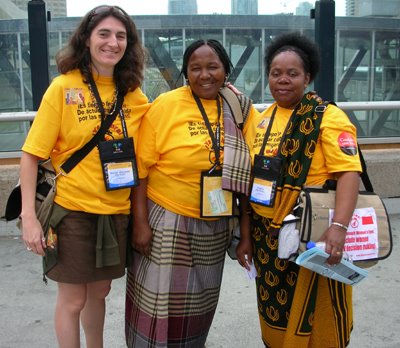
Trade unionists Maria de Conceica and Regina Fernando from Maputo, Mozambique were there with Jessie Wanyeki Forsyth, a CUSO union campaign advisor in Mozambique.


In Mozambique, national adult HIV prevalence is estimated at just over 16 percent and almost two million people were living with the disease in 2005, according to UNAIDS.

Conceica and Fernando run a campaign for HIV/AIDS and gender rights in Maputo.

"There must be equality between men and women," Conceica said. "Men must no longer feel that they are the only bosses of the family, women must be able to feel free to negotiate safe sex."

They want to ensure that agreements over medications to treat the virus made between governments and pharmaceutical companies are upheld.

“We came so that our own voices join with the voices of people from all around the world to ensure that we must end AIDS, and to ensure there is genuine solidarity between all different people to end the pandemic,” said Fernando ~


TWO SPEAKERS OF NOTE

U.S. Congresswoman Barbara Lee, D-CA, spoke of the legislation she introduced in June to reduce the vulnerability of women and girls to the disease. The Protection Against Transmission of HIV for Women and Youth Act, would require President George W. Bush to address 12 key issues that contribute to gender disparities in the rate of HIV infection.


AIDS is the leading cause of death for African-American women between the ages of 25 to 34 years in the U.S., according to UNAIDS statistics.

The act would address social and cultural factors contributing to women’s vulnerability, such as lack of access to prevention methods, the stigma attached to HIV, as well as discrimination against women and lack of education, according to a press handout on Lee's Website.

The bill would amend an act from 2003, which focuses on "abstinence-until-marriage" programs. Proposals include increasing access to female condoms, reducing violence against women, coordinating HIV prevention services with existing health care services, promoting gender equality and encouraging the creation and enforcement of equal rights for women.

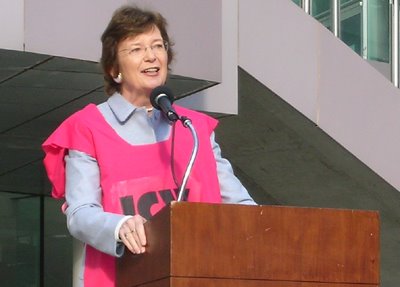
Mary Robinson, president of Realizing Rights, spoke about the need to unite women fighting against AIDS with women involved in the feminist movement to create powerful leadership that could generate effective change.


Robinson served as UN high commissioner for human rights from 1997 to 2002 and as president of Ireland from 1990 to 1997.

"What I have learned is that women are giving leadership, they're fighting back, they're doing it in very difficult circumstances, in poverty, with many barriers, and their courage and their resilience is truly remarkable," Robinson said. "The problem is that they are not the decision makers on the legislation, on the policies, on the programs." ~

Aug 6, 2006

Popularity of Poutini cocktail surges


A Poutini cocktail craze seems to be taking off amid buzz over the projected launch of a chain of poutine and chicken restaurants in the United States this fall.

Poutine Queen, a reader of this blog, submitted the photo of the Poutini shown above.

"I took Bob the Bartender’s advice and here is my latest version of the classic Poutini," she said, referring to an online chat with the bartender about the challenges she faced while mixing the drink, which is made of beef-flavoured vodka, gravy schnapps and Irish-potato liqueur.

"I garnished mine with crispy fries instead of a cheese curd. You can see that I did NOT overblend," Poutine Queen said.

Their conversation is documented in comments below the blog entry titled "Recipe reveals secrets of the Poutini."

Poutine Queen did not stop with the Classic Poutini, but also created a more tropical variation of the cocktail.

"We were finding that the poutini was a bit heavy in this hot weather so we developed a summer version," she said.


"We replaced the beef-flavoured vodka with a more refreshing Stolichnaya potato-lemon vodka, the gravy schnapps with Crème Hollandaise and the potato liqueur with the D’Abruzzo Bocconcini liqueur.

"We’ve garnished the drink with small bocconcini, a variety of summer berries and floated the traditional cheese curds on top."

CURDS 'N' BIRDS

A friend in Washington, D.C. says the first Curds 'n' Birds restaurant is set to open at the intersection of Wisconsin and M Streets in the upscale neighbourhood of Georgetown.

"We’re trying to get Celine Dion and William Shatner to come for the grand opening," he said in an instant message this week. "We’re after people who can eat a bite of poutine."

Rumour has it that former Canadian Prime Minister Jean Chrétien may cut the ribbon at the opening ceremony.


POUTINE PITFALLS

In 2000, George W. Bush, at the time a U.S. presidential candidate, was duped into answering questions on camera about Prime Minister "Jean Poutine" by Rick Mercer, a Canadian comedian.

Mercer used the footage for the weekly "Talking to Americans" segment of his program "This Hour Has 22 Minutes." The segment mocked Americans by making them look ignorant about Canada.

Bush was asked by Mercer to comment on an endorsement by Canadian Prime Minister "Jean Poutine," as well as the "traditional visit to the U.S." of the "King of Canada," Lucien Bonhomme (a.k.a Lucien Bouchard, former premier of Quebec), according to Wikipedia.

Bush told Mercer that he looked forward to working with Chrétien and to the king's visit, the online encyclopedia says.

On his first official visit to Canada in 2004, Bush quipped: "There's a prominent citizen who endorsed me in the 2000 election, and I wanted a chance to finally thank him for that endorsement. I was hoping to meet Jean Poutine."


As he plans the opening festivities, my friend is also mulling over the feasibility of opening a small offshoot Birds 'n' Curds poutine stand where Avon Place and Cambridge Place meet near the intersection of 30th and R Streets in leafy Georgetown.

"You could get carry-out and take it over to eat at the Oak Hill Cemetery on a nice afternoon," he said ~

Jul 30, 2006

Recipe reveals secrets of the Poutini


Today my entrepreneurial friend in Washington, D.C. sent me the following Poutini cocktail recipe in an email message.

He tells me he's starting up a poutine and chicken restaurant called Curds 'n' Birds at the intersection of Wisconsin and M Streets in the upscale neighbourhood of leafy Georgetown.

"I had the bartender at Curds 'n' Birds whip up his signature drink--the Poutini--for your blog readers," he said of the photo of the muddy concoction, which is shown above.

Poutini Recipe

4 oz (118 ml) Smirnoff's beef-flavoured vodka
2 oz (60 ml) DeKuyper Gravy Schnapps
1/2 oz (15 ml) Bailey's Irish Potato Liqueur

Mix well in shaker, pour into a chilled Martini glass, and garnish with a generous cheese curd.


"Of course, the real purists put in a generous amount of shredded beef, firmly believing that it's not really a Poutini unless you need to chew it," he explained.

"And I'm sure you're aware that for drinkers who prefer seafood to beef, we offer the Sardiney Poutini -- uses a fish-flavoured liqueur."

He promises to share the bartender's recipe for the Vegan Poutini at a later date ~

Jul 26, 2006

Curds 'n' Birds & Byzantine poutine


Construction of a specialty poutine and chicken restaurant in Washington D.C. called Curds 'n' Birds is well underway, witness reports indicate.

The brains behind the operation gave me a recent update about what's going on at the site, which is in upscale Georgetown at the intersection of M and Wisconsin Streets.

"Off to meet the decorator," he said in an instant message on Saturday. "Today we choose the colour scheme for the restaurant. Very important. Colour-wise, we're going with something called 'poutine green' with highlights and trim in 'gravy brown'."

He expects a poutine craze to take off and balloon into a chain of restaurants across the United States.

There's already buzz in the U.S. midwest over the prospect of ready-to-go poutine.

"Why is poutine not available in Wisconsin?" queried a resident of the Cheese State. "Given the standard Wisconsin diet is french fries and cheese curds, you'd figure they would have adopted poutine by now! Idiots. Tell your friend to open up his first stand in Racine. He'll make millions."


Research into the history of poutine in Canada shows that there is a wide variety of recipes beyond the standard medley of fries, gravy and cheese curds served up in restaurants of such urban centres as Toronto, Montreal and Quebec City.

Some poutine recipes are said to have originated among French-speaking Acadians of Atlantic Canada. Acadia was first settled as a French colonial territory in the 1600s on the east coast of Canada and the United States.

For example, poutine râpée is a ball made of a mixture of grated raw and mashed potatoes.

Sometimes poutines râpées, which are boiled in water or stewed for a few hours before being squeezed dry in a cloth bag, are stuffed with chopped salt pork.

An online source describes a variation known as poutine en sac as an “old European pudding steamed in a cloth bag.”

Poutine à la vapeur is made of lard, sugar, eggs, flour, milk and baking powder. Dried or fresh fruit is added to the mixture and it is made into a large ball, placed in a cotton bag and steamed for a couple of hours. It can be served with cream, brown sugar, or slices of fried pork. This variation is also known as son-of-a-bitch-in-a-sack, bugger-in-a-bag, cloutie and figgy duff.

Poutine à la mélasse is a pie and poutine au pain is bread pudding.

Then there is the American Poutini, the vodka and potato schnapps cocktail with cheese curds floating in it created by my friend in leafy Georgetown especially for his Birds 'n' Curds chain.

"Those drinks are wicked," he said. "The gravy and frying oil help carry the alcohol right to the bloodstream." ~


For more about poutine, please click on the blog entry entitled "An obsession with poutine cuisine."

Jul 25, 2006

Milwaukee museum targets racism


It's a small museum with a big mandate.

America’s Black Holocaust Museum in Milwaukee is far from the South where lynching and slavery were most common, but physical distance does not dilute the powerful message against racism presented by this small centre.

James Cameron, who founded the museum, was the only known survivor of a lynching in the United States until his death on June 11 at the age of 92. He fought against black oppression on a variety of fronts throughout his life and memorialized his experiences in the museum he started in the basement of his home in 1988.

In 1930, Cameron and two friends were falsely accused and jailed for murder of a white man in Marion, Ind.

A mob of thousands gathered around the jail and the three were dragged outside. Cameron's two black acquaintances were hanged, and when a noose was placed around his neck he thought his fate was also sealed.

However, someone in the mob declared Cameron’s innocence and he survived to serve a four-year jail term for accessory before the fact to manslaughter. After he was freed, he worked at various jobs, went to trade school to become an engineer and became politically involved in the civil rights movement. He became recognized for his lifelong efforts to defeat racism.

“It took 63 years for the State of Indiana to pardon him,” said Bethany Criss, community partnership coordinator at the museum, during an interview. “They pardoned him because it was a bogus charge. It was something that was a completely unrealistic charge, something that couldn’t be validated in modern understandings of the law.”

Cameron's museum proposes that the black holocaust began with the capture of Africans and their enslavement in the U.S. and that it still exists to this day.

“A holocaust is a genocide and genocide is a destruction of a people, not just through murder but through cultural destruction and intellectual destruction,” Criss said.

“As long as there’s racism in society then this holocaust is going to continue and that’s why we’re here. We want to educate people about the evils of racism.”

Almost four million people were freed when slavery was abolished in the United States in 1865, but being legally free was not the same as being released from the shackles of racism.

In the south, whites instituted “Jim Crow” policies in 1877 to strip blacks of rights gained during the 12-year Reconstruction period at the end of the Civil War. These laws governing segregation came into effect to keep blacks and whites separate. Taxes and literacy tests were used to discourage blacks from voting. The Ku Klux Klan, a white supremacist group, terrorized and intimidated blacks.

Almost 3,500 blacks and 1,300 non-blacks were lynched between 1882 and 1968. Lynchings were recorded in all but six states, with the majority occurring in the South.

The museum takes a broad perspective on racism.

“Racism is not just a problem localized in the South,” Criss says. “Racism is a problem that’s concentrated throughout the entire world. To think that it’s localized in one region, well, that’s part of the problem that we want to address.”

The museum includes exhibits on African culture, slave ships, slavery, lynching and the history of the civil rights movement in Milwaukee.

A touring exhibition focusing on the Jim Crow era of segregation from the Jim Crow Museum of Racist Memorabilia in Big Rapids, Michigan, entitled “Hateful Things” is on show until August 26, 2006.

The character “Jim Crow” was created in the early 1830s by a white actor named Thomas Rice. "Daddy Rice" performed a song-and-dance routine in blackface with the lyrics “Jump Jim Crow.” The expression became a racist term used to refer to African Americans.

The items in the exhibit, which date from the late 19th century to the present, made it seem socially acceptable to mock black America, Criss said.

“Lots of those same images were around at the time that those lynchings were occurring, so you see they are directly connected to this concept of black America as less than human, something less than equal.”

The exhibit includes images of Aunt Jemima pancake flour. Aunt Jemima represents the stereotypical “mammy caricature” of black women: an asexual, ignorant caretaker whose only role in life is to serve others, Criss explained. Although Aunt Jemima’s appearance has undergone changes over the years in an effort to make her seem more politically correct, she remains a caricature, Criss said.


“The overall problem is the ideology behind the creation and the use of marketing a black image in such a fashion. No matter how they change Aunt Jemima’s image, it’s based in racism. It’s based in a racist depiction of black people and that’s why it’s in the 'Hateful Things' exhibit."

Artifacts celebrating Cameron’s personal achievements are also on view in the museum. His pardons from Marion and the State of Indiana and his honourary doctorate from the University of Wisconsin in Milwaukee for his work on race and racism are also displayed.

For Criss, the most important item from Cameron’s mementos is an enlarged replica of the June 2005, apology made by the U.S. Senate for never passing an anti-lynching law. Cameron, along with 200 relatives of lynching victims, was in Washington, D.C. to receive the apology.

If someone were to be lynched now it would most likely be prosecuted as a hate crime, Criss said.

“Even though there are no anti-lynching laws today, the significance does not die. It’s still important that on some level, the government acknowledged that they were somewhat, partially culpable in not having protected its citizens. That’s the huge importance of that apology.”

As for the future of the museum, Criss has no doubt that it will continue to be a focal point in the historic neighbourhood of Bronzeville, which was once the hub of black life and culture in Milwaukee. The museum plans to broaden its scope "to be more inclusive for all generations so all generations can reflect on this history.” ~

Jul 12, 2006

Donkey, can you spare a dime?


American Democrats living outside the United States now have the option of joining the DexPat Leadership Council to help spur their party to election victory.

It costs between US$2,500 and $26,700 to join depending on membership level.

The U.S. Democratic Party recently formed the council “to provide resources that will help Democrats win elections and get our country back on track, not least to regain its standing in the global community,” says a handout on the party’s website.

Members will receive emails, participate in global conference calls and attend an annual dinner in Washington, D.C. , the website says. They will also attend exclusive dinners and other events with top-level democrats.

So far, there are only 25 members, none of whom live in Canada, according to a DexPat insider who said he attended a dinner at which he spoke to President Bill Clinton.

“We’re just fortunate that we can afford the $5,000 to join,” the insider said.

Democrats Abroad, another organization for politically active Americans living outside the U.S., says on its website that it represents more than six million people.

Jul 2, 2006

Windproof flag makes flapless debut


A flag is generally a rectangular piece of decorative cloth attached to a pole. It's at its best when it’s fluttering in a breeze or flapping in a gale.

Or so you would think.

But for my father, who hangs a 1.5 metre-long (five foot) government-issue maple-leaf flag each Canada Day from the second storey of his house, the fluttering and flapping generates problems.

At times, his flag flies so fast in the wind that it wraps itself tightly around its horizontal flagstaff and remains there.

He tried weighting the flag by attaching large metal washers with safety pins to its corners to keep it free, but the wind was so sharp it knocked them off.

In frustration, he decided to make a windproof flag out of a brick he found in an alley. It seemed a suitable shape for a flag, he said.

“I don’t have to worry about it wrapping itself around the flagstaff because it sits on its flagstaff,” he said. “The only thing I have to worry about is a raccoon knocking it off and smashing it.” ~


More to come on this topic later~


Jun 18, 2006

An obsession with poutine cuisine


It seems that poutine, a popular French-Canadian dish made of French fries, cheese curds and gravy, may soon be available throughout the United States.

A friend told me last week that he intends to sink his life savings into starting a chain of American poutine restaurants. If the plan comes to fruition, he expects the first location to be at the intersection of Wisconsin and M Streets in the heart of Georgetown, an upscale Washington, D.C. neighbourhood.

“We’re working on a marketing plan now,” he said in an instant message on Wednesday. “It looks like we’ll be serving fried chicken and poutine and calling the place Curds ’n’ Birds.”

Although the mere thought of poutine triggers the gag reflex in some people, my friend, a resident of leafy Georgetown, became fixated on the idea of profiting from mass sales of the dish after he found out that in eastern parts of Canada it is as popular as hockey and beer.

Cheese curds are small, rubbery pieces of fresh cheddar that have not yet been pressed or aged. Poutine is French-Canadian slang for the word “mess.”

The creator of the dish, Fernand Lachance (above), died in 2004 at the age of 86 in Warwick, Quebec, a small town 138 kilometres (86 miles) northeast of Montreal.

Legend has it that Lachance first made poutine after a trucker named Eddy Lanaisse came into his restaurant, Lutin Qui Rit, in September 1957 asking for a mixture of cheese curds, fries and gravy.

The food is now standard fare throughout much of eastern Canada and is sold in pubs, diners and fast-food chains. Some restaurants serve up such variations as “Italian poutine” with meat and tomato sauce, or “Chinese poutine” with meat and barbecue sauce.

At Birds ’n’ Curds, the signature dish of curds, fries and gravy will be called “Routine Poutine.” The chain will also serve heath conscious variations on traditional poutine with such dishes as the low calorie “Lean Poutine” and the “Green Poutine” salad.

Diners will be able to wash down their poutine with the “Poutini” a vodka and potato schnapps cocktail with cheese curds floating in it ~

Jun 6, 2006

Overpriced lodgings in New York City


In my experience, most bed and breakfast owners love to regale their paying guests with long tirades about their travails—business or otherwise—over breakfast.

That’s why I usually avoid B&Bs and stay in hotels when I travel.

My most recent B&B experience occurred in April 2006 when Reuters sent me on an expenses-paid trip to New York City for a week of boot-camp training. I decided to stay four extra days at my own expense. Extending my stay seemed like a good way to maximize the value of a free plane ticket.

It proved more difficult to find affordable accommodations than I expected. I was surprised at how much more expensive New York City has become since I was last there in 1997.

After exhausting the leads on several “cheap hotel-room” websites, a couple of guidebooks and suggestions from friends, I followed up with a couple of B&B organizations.

The cheapest non-B&B alternative I had found was a US$90 per night hotel room in Midtown Manhattan that would require I share the bathroom with the occupants of two other guestrooms. It sounded a little sketchy. Especially after the woman at reception in the hotel said: “I don’t think you want that.”

The B&B I settled on was what turned out to be a fold-out chesterfield in the living room of a one-bedroom apartment in a 1930s apartment building a few blocks from Macy’s for US$110 a night. It was the cheapest one I could find without pets. (See picture above).

There was no door on the room, just a curtain and a screen. The room was done in a very lush Victoriana style with a lot of pink fabric, Turkish carpets, heavy antique furniture and curios.

BOOT CAMP

Reuters booked me into the Club Quarters Hotel on West 45th Street for the training period.

The training consisted mostly of speakers explaining their news beats and practising story writing. The attendees included print and television journalists from other North American Reuters bureaus. We attended a panel talk one evening about news media coverage of Iraq and, on another, a dinner at Trattoria Dopo Teatro on West 44th Street. One evening I went out for a fancy Greek dinner at Avra Estiatorio on East 48th Street with a friend from high school.

FINE ART IN MANHATTAN

The day after boot camp ended, I went to the Guggenheim Museum, which was completely clad in scaffolding as it is undergoing exterior restoration work, and saw the David Smith centennial sculpture retrospective. I liked the Wassily Kandinsky paintings in the permanent collection.

I saw the Edvard Munch exhibit at the Museum of Modern Art. His work is somewhat formless unless the image is graphic. It reminded me a bit of the formlessness of Paul Gauguin’s work, but it’s not nearly as good. The footprint of the MoMA redesign is somewhat confusing. At times it was difficult to find a direct route through the various galleries, which made it hard to know if I’d missed anything.

The biennial at the Whitney Museum of American Art, which I went to after brunch at Vento on Hudson Street, included some interesting work. I went quickly through most of the galleries, but spent a lot of time looking at the Kenneth Anger video and photography.

I especially liked the display of Alexander Calder’s “Circus" (1926-1931) in the Whitney permanent collection. There is an accompanying video loop of Calder playing with the circus characters.

I wanted to see a painting by Jay DeFeo entitled "The Rose" (1959-1966) because I like Bruce Conner's film entitled "The White Rose" (1967) which eulogizes the complicated job of removing the painting from DeFeo's San Francisco apartment to the melancholy tune of Miles Davis' "Sketches of Spain."


The painting, made of lead paint, measures 3.3 by 2.4 metres (11 by 8 feet) and weighs 1,035 kilograms (2,300 pounds).

Last September I went to see it at the San Francisco Museum of Modern Art only to discover that it wasn't there. It is now in the Whitney’s permanent collection. I was surprised that none of the staff on the main floor information desks or in the bookstore knew about it, but even more surprised that none of them looked it up for me. I ended up asking a security guard in one of the galleries who told me it had been on show, but is no longer.

In San Francisco, I saw DeFeo's "Incision" (1958-1961), a bleak oil painting from the same period as "The Rose" measuring approximately 2.7 by 1.2 metres (9 by 4 feet).

TOURING THE CITY

My four-day visit included watching a clown perform in Central Park, wandering on Fifth Avenue and Wall Street, going to the World Trade Center site, Battery Park, Little Italy, Chinatown, Canal Street, Washington Square, Union Square, Soho, Village, Tribeca, Macy’s, Grand Central, United Nations building, Park Slope in Brooklyn, lunches, brunches, dinners and so on.

I was escorted into a black market purse shop on Canal Street. There were lots of Prada and Gucci knock offs. Some men on the street offered to sell me a fake Rolex watch for US$500.

I went on a paid tour of the United Nations building. The U.N. tour guide said that Canadian artist Henry Moore made the bronze sculpture standing outside the building. I did not bother pointing out that Moore is actually from Britain. However, when the tour guide later referred to U.N. troops in Afghanistan I pointed out that those troops are really a U.S.-led Nato force. He acknowledged it is true and then explained the role the U.N. is playing in the region.

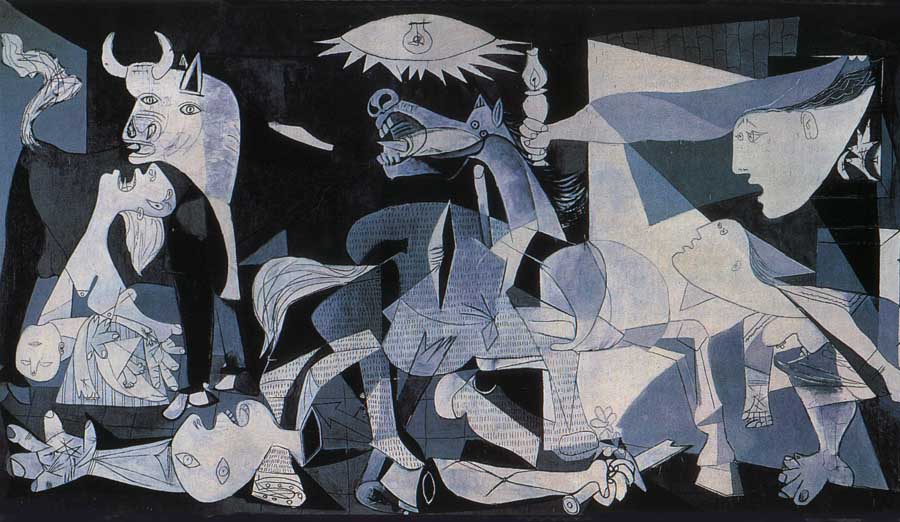
The paid tour did not include a viewing of the tapestry of Picasso’s “Guernica.” I was curious to see it because I saw the 1937 Cubist anti-war painting long ago at a MoMA Picasso exhibit.


The painting depicts the aerial bombing on April 27, 1937 of the Basque city of Guernica by the German Luftwaffe, which killed some 1,600 people during the Spanish Civil War. It was commissioned by the Spanish Republican government for exhibition in the Spanish Pavilion during the Paris International Exposition in 1937 to commemorate the first intentional aerial bombardment of civilians.

The tapestry, which hangs outside the U.N. Security Council, became the centre of a controversy in Feburary 2003 during the lead up to the U.S. war in Iraq. It was concealed from view by a blue cloth and a row of flags when then U.S. Secretary of State Colin Powell presented the U.S. case for war. U.N officials denied charges of a "cover up" when a dispute arose over whether the concealment of the tapestry was politically motivated.

I managed to get in touch with someone in the U.N. building who took me to see the tapestry. He also showed me the delegate’s bar and said it is known as the Star Wars Bar because the delegates wear their national dress when they go for drinks.

I saw only one play—"Rabbit Hole"—recommended by some friends who said it was the best play they’d seen, and they said they’d seen everything. It was good, but not great, not worth US$90 and the theatre was freezing cold. The script was a little weak and wasn’t helped by some not-so-great acting. It’s since been nominated for a Tony Award.

After the play, I went to the Blue Bar in the Algonquin Hotel and watched a diminutive, stooped man billed as the oldest bartender in New York City work while I sipped a US$14 mojito. He's said to be in his 90s. I wanted to go to the Algonquin because I was wearing the pearl necklace of the wife of Canadian Press journalist Al Colletti who was one of my father’s friends. My parents went to his wife’s funeral in New York City some years ago and he gave them her necklace in the Blue Bar. She was cremated and he took her ashes to New Orleans. He hired a jazz band to accompany him as he walked her ashes to the river and threw them in the water. He hadn’t had a drink for 25 years until she died, but afterwards he went to a bar and drank and drank and drank.

THE BED AND BREAKFAST

The B&B I stayed in turned out to be OK, although I was victim to the usual B&B-owner complaints. The host is in her 70s and said she hasn’t worked for more than a year because of ageism.

There were dead cherry blossom boughs in enormous vases in the room.

“Unfortunately, you’ve missed the full bloom of the blossoms,” she said almost wistfully. But I think she may have gotten them out of the trash somewhere. They were a bit of a hazard. I got one of the branches caught in my hair as I walked by and just managed to save the vase and boughs from pitching to the floor.

When prompted, she told some rather horrifying B&B tales. She said she would tell future guests about how I don’t eat eggs or drink coffee. “You certainly burned the candle at both ends,” she said disapprovingly the morning before I left.

That morning there was an insect floating on its back in my orange juice.

I left her a bouquet of bright pink, turquoise and blue daisies and some gourmet jelly beans done up in a bag with real ribbon to try and earn some positive spin in her future tales ~