Showing posts with label Doug Dowen. Show all posts

Apr 13, 2012

New World v Olde Worlde: stranger in a familiar land


This post was commissioned by @DougDowen and originally appeared on his blog The Common Voice

If my calculations are correct, I’ve moved 31 times.

I’ve moved as a resident between Britain and Canada four times, and between the United States and Canada twice.

I’ve lived in 10 different places in Toronto, where I was born. I’ve also lived in various places in Ottawa, Stratford and Gananoque, Ontario, and Halifax, Nova Scotia.

In each of Washington, D.C., and Edmonton, Alberta, I had only one abode.

I consider myself fortunate to have moved about so much, although each move has resulted in both gains and losses.

Without a doubt, returning to Britain in 2008, where I lived as a child, has been the most disorienting move of all.

For some reason, almost everyone assumes I’m an American citizen.

LONDON CALLING

The weirdest thing about moving to London has been that I’ve felt more alien in this familiar place than in any of the unfamiliar places to which I’ve moved in the past.

I had been with Reuters for three years when I applied for a position in 2008 and was transferred to work on the online desk in London.

My earliest memories are here.

My mother is from a small village called Grayshott on the Surrey-Hampshire border. As a child, I spent a lot of time with my grandparents in their home, Bidston, on Crossways Road.

To me -- a person without a proper root in any particular geographic location -- Britain is a home country, but no one I meet realizes it because of my Canadian accent.

It’s perhaps not so surprising that almost everyone in Britain assumes I’m from “America” because of the similarities between certain U.S. and Canadian English-language accents.

What seems truly funny is the disdainful treatment I receive due to my supposed “American-ness” by the citizens of a country so economically, politically and militarily tied to the United States.

ENGLISH, CANADIAN, AMERICAN ROOTS

My mother is English, her parents were English and Welsh, and so on up the generations, as far back as I know.

My father is Canadian.

My father’s father was born just outside Boston in Melrose, Massachusetts, but lived most of his life in Canada.

During the First World War, my grandfather served from 1915 to 1918 in Horsham, England, and on the battlefields of France as an artilleryman with the 2nd Canadian Siege Battery, which was later incorporated into the 98th Canadian Siege Battery.

His parents, my great-grandparents, were Canadian.

Their ancestors, who emigrated to New Brunswick, Canada, in 1813, were also English, from the region now known as Cumbria.

We can trace my Canadian grandmother’s ancestral presence in the New World -- to New England in the United States -- as far back as the 1700s.

As Nickersons, Armours, and Sowerbys, we think they were Scottish and English.

MYSTERIOUS FOREIGNER

Of course, sounding like a foreigner in a society which places a premium on accents -- see George Bernard Shaw’s 1912 play “Pygmalion” in which the upper class Henry Higgins teaches Eliza Doolittle, a Cockney flower girl, to speak “proper” English -- can have its benefits.

Very few strangers can “pigeonhole” me accurately.

There’s a certain amount of freedom in being an alienated, passport-carrying, classless stranger in a familiar land.

The opinions and viewpoints expressed are those of the author, and do not reflect the opinions and viewpoints of her employer, nor any other professional entity with which she may be affiliated.

Oct 24, 2011

Being a Road Scholar by @DougDowen


I invited Doug Dowen to write a guest post for TellingTales after he asked me to do the same for his Common Voice blog. I've never met Doug in person -- we know each other via Twitter. I'm fascinated that he manages to blog each day. Here, he explains how he got started and shares his views.

What does it take to be a "Road Scholar"? There are no real qualifications, actually.

Late last year I was contemplating making some sort of entrance into the blogosphere. I tossed an idea out via Twitter... just to see what kind of feedback I could garner.

I actually didn't know what to expect, but, surprisingly, a couple of my mutual follows on Twitter called me to the challenge to blog every day for a year. That may seem like nothing exciting, or even remotely interesting, but since I drive a truck throughout the U.S. I thought there may be some good stories on occasion.

 The term "Road Scholar" - as is obvious to see - is a play on the term "Rhodes Scholar." I've never gone to college, but there is a lot one can learn driving a truck (I've learned more about geography as a driver than as a high school student).

 However, "The Road Scholar" series is more than just a blog of a truck driver... at least I hope it is. Hearing about bad experiences at a grocery warehouse generates little, if any, interest.

 But to get a basic understanding of the different cultures, from small towns to metropolitan cities (not to mention the different attitudes as well), and the periodic snapshot of picturesque scenery than many may not have the opportunity to see otherwise... now THAT would make for good reading material.

I do go on a rant from time to time, whether it's to point out the erratic behavior (and complete disregard for others - and that includes OTHER truck drivers), or venting my frustration of self-serving protests (the "Occupy" movement) or irresponsible leadership (our own government)... well, that can also make for good reading.

 I've always tried to present a neutral point of view when opining on social/political subjects. Basically, "The Road Scholar" is about one man's perspective of the country that he drives through on a daily basis, and presenting it to others - with photographs, whenever possible - whom either would not see it any other way, or take such panoramic views for granted.

There's a long road ahead - I hope you'll come along.

Doug spent eight years in the U.S. Marine Corps. Now he drives a truck. He's been happily married for 18 years and has four sons.

Oct 8, 2011

Battling borders


I wrote this post for The Common Voice blog. Twitterfriend @DougDowen asked me to write for his blog as a stand-in while he was observing Yom Kippur, a Jewish holiday.


I’ve often thought about how much more difficult setting up a new life in London would have been without social media.

Through Twitter, since moving to London from Toronto in 2008, I’ve been able to make new friends in England and keep in touch with old friends in Canada.

When I was a child, my mother -- who is English and emigrated to Canada with my Canadian father in the 1960s -- relied on snail-mail letters from family and friends to stay in touch.

I’m lucky because I have a Canadian and a British passport, which means I can travel freely to Canada, Britain, the United States and the 27 countries of the European Union without needing a visa.


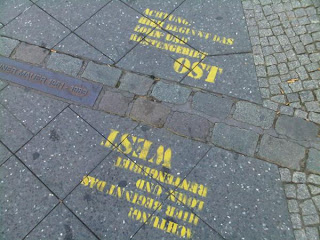
Last weekend I went to Berlin, where invisible and visible borders destroyed so many lives in the 20th century.

Nazi rule in Germany after 1933 destroyed Berlin’s roughly 200,000-strong Jewish community by enforcing exile to the Sachsenhausen concentration camp or to death camps. 


After the Second World War, Berlin was divided first into four sectors among Russia, France, Britain and the U.S. and later, in 1961, split into communist East Berlin and capitalist West Berlin.

The Berlin Wall, constructed to prevent an exodus from east to west during the Cold War, separated families and friends again until it was smashed in 1989.


Now the city commemorates the Holocaust with the dramatic Memorial to the Murdered Jews of Europe, designed by Patrick Eisenman, and engineer Buro Happold, made up of concrete slabs, and via tributes in the decade-old Jewish Museum, designed partly by architect Daniel Libeskind.


The divisive wall is also commemorated throughout the city with markings on the ground, pieces of wall and a museum at Checkpoint Charlie, which marks the  border crossing between the old East and West Berlin.


Estimates vary, but between 100 and 200 people were killed trying to escape from east to west.


To a tourist, reconstruction, reconciliation and remembrance characterise modern-day Berlin.

Old scars remain.

May 15, 2011

English pancakes, or Shrove Tuesday


I sent this to an American I know from Twitter who wanted the recipe for English pancakes -- shortly after March 8 - Shrove Tuesday.

I don't have my mother's recipe in London, so I use a recipe from a Gary Rhodes cookbook my sister gave me a few years ago titled "New British Classics".

My mother is English and my father Canadian. They met in London and then moved back and forth between the UK and Canada several times as well as the United States.

My mother started a tradition of serving my sister and me English pancakes when we were children, but later in life hated making them.

She would often not tell us when it was Pancake Day, so she wouldn't be coaxed into making them.

She much prefers to make Canadian pancakes, which are far simpler.


Although the Rhodes recipe below does not specify, I have always eaten English pancakes, which are like crepes, with white granulated sugar and either freshly squeezed lemon juice or orange juice. 


I have always preferred orange juice to lemon as I find it too sour.

My mother taught us to sprinkle sugar over the pancake, then drizzle juice over it, roll it up and sprinkle a bit more sugar and juice on top.


These are tedious to make as you have to put the batter on the pan and then tilt it around to ensure the batter spreads out thinly on the pan.

After pouring the batter, I wait for until the edges are cooked through and peeling away a bit from the pan. Then I shake the pan so the pancake loosens. Once it is getting cooked through I flip the pancake on the pan rather than using a spatula to turn it.

For maximum efficiency and to cook these up as quickly as possible, I would recommend using two frying pans. Otherwise it seems to take forever standing at the stove.

I hope you enjoy these if you make them.

Gary Rhodes
New British Classics

Home-made Pancakes

Pancakes were among the very early enriched breads cooked on the griddle and have become one of our favourite breakfast and afternoon tea foods. They have a long-standing yearly association with Shrove Tuesday, otherwise known as Pancake Day, which is when all the eggs must be used up before Lent.

Pancakes are a Sunday treat in our house, with my sons and me whisking away making the batter.

And then I cook the pancakes, while they eat them: I'm making a mistake somewhere! But they are so easy to make and with a dribbling of golden syrup, just delicious. They could also be served with honey, jam or ice cream. In a savoury sense, they can be filled with ratatouille, fish stew, mussels, chicken and so on.

This quantity will make 16-24 pancakes, depending on the size of pan used. It is best to use a 20 cm (8 in) or 15 cm (6 in) frying pan.

- 225 g (8 oz) plain flour (all purpose in North America)
- Pinch of salt
- 2 eggs
- 600 ml (1 pint) milk
- 50 g (2 oz) unsalted butter, melted
- Vegetable oil, for frying

Sift the flour and salt into a bowl. Whisk the eggs and the milk into the flour. Add the melted butter and whisk into the mix. At this stage, the mix can be used for sweet or savoury pancakes.

For a stronger savoury flavour, chopped fresh parsley or mixed herbs can also be added.

To cook the pancakes, pre-heat the frying pan. Lightly oil the pan and pour in some the mixture, making sure the pan has only a thin layer of mix by tilting and rotating the pan to make the batter spread out.

Cook for 30-40 seconds, until golden brown. Turn the pancake over and cook for a further 20-30 seconds.

The pancake is now cooked. Keep warm between squares of greaseproof paper, while you cook the remainder. Two or three pancakes per portion should be plenty.

If made well in advance, the pancakes can be microwaved for 30-40 seconds to re-heat.