Showing posts with label Grayshott. Show all posts

Dec 11, 2009

Growing up without Grayshott

This story was written for the Grayshott Parish Magazine and published in November 2009.


Some of my earliest childhood memories were generated in the small Hampshire village where my maternal grandparents lived when I was a child.

A recent bittersweet return visit to Grayshott after a 20-year hiatus was a bit of a disorienting experience, which highlighted the complexities of remembrance and reality.

My grandparents, Herbert and May Levett, lived at "Bidston" on Crossways Road.


Their daughter, my mother, Joan, married Carl Mollins, a Canadian journalist working in London with Reuters, the news agency, 50 years ago on March 21, 1959, at St Luke's Church.

A clipping from the weekly Hindhead Herald newspaper dated March 28, 1959, describes the event:

"The vicar (the Rev. Dr. A. R. Winnett) conducted the wedding service, during which the hymns 'Lead us, Heavenly Father,' and 'Love Divine' were sung. Given away by her father, the bride wore a short full-skirted white lace dress with long fitted sleeves extending in points over the hands, a coronet of orange blossom, and short veil and white satin court shoes.  Her bouquet was of roses, freesias and hyacinths in spray form."


We moved several times when I was a child, which meant we lived in London for only three years before we returned to Canada, where, apart from four years in Washington, D.C., I spent most of my life.

It was an easy trip from London to Grayshott by train and we often visited my grandparents. A cosy, loving atmosphere warmed their chilly home, which was always surrounded by the scent of a bonfire burning rubbish in the garden.

Inside, my sister Tracey and I whiled away the hours by looking at the multitude of ornaments in parlour and sitting room, while outside, we played in tents and with what seemed like a vast amount of plastic garden gnomes and animals.

I also remember the trauma of such outdoor threats as being jumped on by a dog while I was being trundled along the sidewalk in my pushcart.

In an odd twist of fate, since October 2008, I have been working at Reuters in London as my father did, just down the street from where he worked on Fleet Street.

I took a trip back to Toronto, where my parents and sister now live, in March and helped arrange a party for their Golden Wedding Anniversary, which about 50 friends attended.

Returning to Grayshott in recent weeks was a melancholic experience in some ways because my grandparents have passed away, Bidston's garden has been irrevocably changed and the war memorial and green, which my grandfather tended after he retired from Naval service, has been altered with a fence and children's playground.


Everything seemed odd as I wandered around the village trying to piece the past together.

I met for a delicious Sunday dinner at the Fox and Pelican pub with Marie Morris, a lifelong friend of my mother's, who visited us in Toronto several times.


We went for a walk to the Grayshott Pottery and to see the school they attended.


In St Luke's Church, I was intrigued to find the names of relatives on plaques commemorating those villagers who served in both world wars, and most importantly, I was glad that my visit brought to life the building featured in many pictures of my parents' happy wedding day on display  throughout their home.

Aug 29, 2006

Stewing over Canadian cooking


My mother is renowned for her creative cooking. This year, during the dog days of summer, she served up a spectacular two-layer blueberry-raspberry shortcake.

I wondered how a British-born-and-bred woman came to make shortcake of any kind, let alone such a splendid variation on the classic North American strawberry dessert.

I asked her if it was a dessert she had made in England before she migrated to Canada in the 1960s.

“I didn’t make it in England because I’d never heard of it,” she explained. “The first time I had it was at a party in Toronto.”

PROFESSIONAL LIFE

My mother moved to London by herself from a small village at the age of 14 during the Second World War. She worked as a nanny and then became a cook.


She looked after a boy in Chepstow Villas in Notting Hill for several years, but one of her most memorable employers was Bill Linnet, a theatre producer who lived in Westminster behind the Abbey. He always ensured that she and her friends got tickets to see the plays he produced in the West End. His chauffeur taught her to drive.

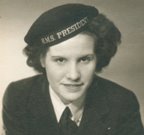
She joined the Women's Royal Naval Service to become a Wren because she wanted to learn to drive a truck. She was trained in Reading and then--the same day the Queen was married on November 20, 1947--she was sent to Greenwich where she was stationed as an officer's steward.


She met my Canadian-born father in London in the mid-1950s when he was working as a journalist on the old Nordesk for Reuters on Fleet Street.

He had lived in a house in Bayswater where she lived and went to collect his mail. He invited her out.

She first moved to Canada some years after she married him. Before she moved to Toronto they socialized with his Canadian friends and colleagues in London.

"Canadians in London went on about the awful food in Britain," she said, which led her to expect excellent cuisine in Canada. She was sorely disappointed.

INTRODUCTION TO CANADIAN FOOD

The first Canadian food she ate was a sandwich she bought on the train from Montreal to Toronto after disembarking from the Italian-owned ship, the Homeric, which had a Greek crew.

“It was revolting,” she said. “I had a roast beef sandwich because everyone had gone on about it, and it stuck to the roof of my mouth.”

She described the party she attended upon her arrival in Toronto where she first ate strawberry shortcake as typically “suburban Canadian.”

“It was the worst night of my life,” she said. “I walked in and there were about 50—all blond—women.”

The dessert was a frozen pound cake with frozen crushed strawberries and fake whipping cream on it.

FAMILY

My mother grew up in a village in the south of England during the Great Depression.


My grandmother worked as a cook in big houses. One of them was called Hillview. It was owned by Cecil Wray, the former governor of the Malay States. The Wrays had made their fortune from rubber in Malay and Kenya.

She worked also for the Ash family who made their money from the cotton industry in Manchester.


My grandfather served in the Royal Navy on HMS Barham and fought in the 1916 Battle of Jutland in the First World War.


He became a gardener after he was forced to retire from service in 1936 after 24-and-a-half years because of a serious knee injury. He had signed up for 25 years of service at 17.


My mother's brother, my uncle, who was 10 years older than her, served on a tank crew in the British eighth army and fought in the North African and Italian campaigns of the Second World War. After the war he worked for the post office and played accordion in a band.


LIVING WITH RATIONS

Food was rationed during and after the war. Meat, butter and eggs were rationed. Everyone grew his or her own vegetables.

“Our Sunday joint was just a few ounces,” my mother said.

My grandparents kept chickens and rabbits. People in the village registered with them to get rationed eisenglass eggs, which were a type of pickled egg. When the chickens got too old to lay eggs they were used for eating.

My grandfather had a goose named Pickles that was given to him by Commander Wrightson, a man for whom he worked at Dower House.

Wrightson helped him get a decent pension from the Navy.

"People shared food," my mother said. "If there were a lot of eggs, people got lots of eggs."

One of their neighbours in the village had throat cancer and everyone gave him bananas when they got them because he couldn’t eat much. They didn’t get much fruit.

My grandmother made dandelion wine and cheese.

Although the war ended in 1945, it wasn’t until the Queen’s coronation in 1953 that rations came off candy.

ADJUSTING TO CANADA

My mother hated Toronto the first time she lived there, but my paternal grandmother, with whom she and my father lived, was very empathetic.


My mother said it was because my grandmother, who was originally from Shediac, New Brunswick and married a Baptist minister, understood what it was like to relocate with children. She lived in several places in the Maritimes and Ontario with my grandfather who served at five different churches in five different cities during his lifetime.


“She came from the Maritimes to Ottawa and it was a big shock to the system,” my mother said. “She left her family behind.”

As to why she started making strawberry shortcake, my mother said: “I don’t know why I made it, it was something all Canadians had. “ ~

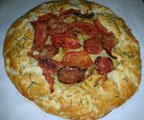
OTHER CREATIONS