Showing posts with label Film. Show all posts

Sep 9, 2007

Queues and exits at the film festival


Today was tough because I had a very early 9 a.m. screening of David Cronenberg's Eastern Promises followed by a 2:30 p.m. screening of Roger Spottiswoode's Shake Hands with the Devil.


Eastern Promises was shown at Ryerson University. There was a densely packed line up of people penned inside crowd-control fences outside when I arrived.

The film started half an hour late. Cronenberg made an appearance to introduce the film.


"What are you doing here?!" he said to the audience in jest because of the early start time. "This is the premiere of this film at this time of day."

The film had its gala premiere opening last night.

He also said that this is the first time he's made a film entirely shot outside of Canada.

Eastern Promises revolves around the story of a woman who dies in childbirth at Trafalgar Hospital in London. It is an urban gangster film about Russians in London--an interesting twist to the genre at a time when west and east seem to be reigniting a Cold War.

Although the film does not specifically make reference to the Alexander Litvinenko affair--Litvinenko was a former FSB officer who died in London last year from radiation poisoning--it shows aspects of the secret underworld of international espionage and gangster activity. The Russian gang is involved in trading heroin from Afghanistan.

In Eastern Promises, Cronenberg deploys elements of the urban gangster film that hearken back to Mervyn LeRoy's 1931 classic Little Caesar, including a strong subtext of homosexuality and impotence.

It also includes Cronenbergesque scenes of over-the-top gore and exaggerated caricatures that delighted the audience. Squeals and groans were heard throughout the auditorium at various particularly grisly points in the film.

GRAND EXIT

After the film, getting out of the theatre was a challenge: It was even more difficult to get out than it was to get in.

I wanted to take the usual shortcut across the Ryerson University Kerr Hall Quadrangle after leaving the screening because I was headed to points southwest of the theatre. However, in order to do so, I had to hastily and stealthily remove several crowd-control fences and squeeze between large oil drum-like containers to make my escape. I think I made a gracious, if illicit, departure from Ryerson considering the circumstances and didn't notice any angry staffers in pursuit.


I had been caught the previous evening trying (oh horrors) to get out the "in" door at the Elgin Theatre and was chastised by front-of-house staff.


After lunching at Eggspectation on Yonge Street with a Facebook friend I once again joined the queue outside the Elgin for Shake Hands with the Devil.

POWER OF VISA

I was with a friend for this screening. We were told that the platinum and gold Visa card advance entry privileges do not apply for films that begin before 6 p.m.

After the screening I buttonholed the front-of-house manager to discuss the procedure for platinum and gold Visa card holders. It turns out that those in possession of the cards are allowed to enter the theatre up to an hour and a half ahead of time. They are entitled to use a lounge where they are given complimentary "things" including Lindt chocolates, she said, and then escorted into the theatre before anyone else so they can choose their seats.

Once inside the Elgin, I made a dash for the balcony and my friend made a dash for the orchestra. I phoned her and we consulted from our respective seats on which was the best location. She felt she would be too close to the screen in the seventh row and came upstairs.

RWANDA FILM

Producer, director and cast all traipsed out on stage to introduce the film, which tells the story of former Canadian General Romeo Dallaire and the U.N. mission he headed in Rwanda in 1993.


The film focuses more on the story of the Rwandan genocide than Dallaire's ability to cope emotionally with the situation, although the film is based on his autobiography. The cinematography is dark and there are titles to explain where and when the action is occurring from time to time.

The film got a standing ovation as did a surprise visit from Dallaire as the credits were rolling.


"This film is part of a campaign to never let the Rwandan genocide be forgotten," Dallaire said. "I believe we have entered an era more evil than the colonial era."

Then--completely unrelated to the film festival--on the way home, there was an unusual sighting on the subway.

Sep 8, 2007

Tales from the film festival queue


Today I saw two films at the Toronto International Film Festival.

Altogether I bought tickets to see 10 films during the festival:

Eastern Promises (David Cronenberg)
Shake Hands With the Devil (Roger Spottiswoode)
Chacun son cinema (35 directors)
Useless (Jia Zhang-Ke)
Paranoid Park (Gus Van Sant)
No Country for Old Men (Ethan and Joel Coen)
A Thousand Years of Good Prayers (Wayne Wang)
Le voyage du ballon rouge (Hou Hsaio-hsien)
It's a Free world... (Ken Loach)
Short Cuts Canada Programme (various)

The procedure for buying the tickets had to be done in stages and was very complicated.

Although I have tickets, it is still necessary to queue up outside the various theatres for at least 45 minutes before each film to get a good seat and prevent the festival from reselling the ticket.

Today I saw Chacun son cinema and No Country for Old Men at the Elgin Theatre on Yonge Street.

The line up for Chacun son cinema was uneventful. I heard later in the day that the film wasn't very well attended so the balcony in the 1,200-seat theatre wasn't opened to the public.


The rake of the orchestra level is not steep enough to see over heads in front properly for film screenings--especially if there are subtitles.

Chacun son cinema
is a collection of three-minute films by 35 directors from various parts of the world. Jane Campion's dark and sinister contribution is the only one made by a woman.

These snippet films give spectators a good understanding of how the world's most accomplished directors can play with and manipulate the medium.

Most of the stories use elements of cinematic tradition to highlight characteristic aspects of movie going. Thus, the film in its entirety--which was made to celebrate the 60th anniversary of the Cannes film festival--has appeal for both film aficionados and standard movie audiences.

The directors make many references to films which are considered among the most important in film history for their technological and artistic innovation.

Three such films are Workers leaving the Lumiere Factory directed by Auguste and Louis Lumiere in 1895, The Rules of the Game directed by Jean Renoir in 1939 and 8 1/2 directed by Frederico Fellini in 1963.

But equally important is that the film provides an example of the way watching films on a mobile phone--a fairly recent technological innovation with a potentially huge impact on spectatorial viewing conditions--could become successful and satisfying in a three-minute format with the right director in charge.

David Cronenberg stars in his three-minute film, which is titled "At the Suicide of the Last Jew in the World in the Last Cinema in the World". It's a commentary on the--at times--absurd coverage of breaking news on television.


QUEUE MAYHEM

There was chaos in the queue outside the Elgin this evening before the screening of No Country for Old Men directed by Ethan and Joel Coen. I got into line about 45 minutes before the 6 p.m. start time. About 15 minutes later I noticed another queue forming alongside mine. I asked a film festival volunteer why it was formed. He said it was for people with special tickets and platinum or gold Visa cards.


About 10 minutes after that, I discovered that it wasn't for people with special tickets, but that it was for people with platinum or gold Visa cards.

It wasn't fair that the rules weren't made clear from the outset. Some people were able to benefit by trading places with those who had been told that the line-up privileges were for people with any kind of Visa card. However, it also meant that some people got booted from spots that were quite far up in the line because they didn't have a card.

Unfortunately, my spot in the line did not give me a clear view of the celebrities who showed up to the delight of fans massed against barricades across from the entrance to the theatre. I shot a few Hail Marys with my very unsuitable camera, but came up with pictures of unknown cops and people.

BALCONY SEATING

I decided to sit the balcony for the Coen brothers screening. A huge amount of seats had been reserved for Visa dignitaries of some sort who never showed up. The seats were later released so that "regular" people could sit in them.

The Coens and a large number of cast members were on hand for the screening, but the brothers only introduced the talent and said nothing else about the film.

Not surprisingly, the narrative of No Country for Old Men is laced with bizarre coincidences and acts of violence. It has all the familiar auteurist qualities of a Coen brothers film. The extent of the unrestricted narration makes it difficult to stick with and identify with any single character.

Feb 22, 2007

Organic encounters with FLW


I was guided through Frank Lloyd Wright's Hollyhock House in Los Angeles by a man who in his childhood lived near Oak Park, Illinois, where many of Wright's early structures were built.

That man, Henry Michel, writes in the forward of his self-published book "Basic Frank Lloyd Wright" (1999) that he is an "expert amateur" who has written two other books on Wright's work.

Whether fact or fiction, Michel's tour of Hollyhock House and his tale of Aline Barnsdall, the theatre producer who financed it, was memorable. He hustled through the gardens and rooms chastising tourists who lingered too long or peered into off-limit areas.

I was travelling alone. The others on the tour were similar to those I've seen at other Wright sites: mainly down-to-earth American enthusiasts in untucked shirts, shorts, tube socks and sneakers.

There were a couple of architects who childishly violated all of Michel's rules by waiting until he had marched off to the next gathering point before darting up forbidden stairways or surreptitiously snapping pictures.

Although I wasn't compelled to join them in their anarchist acts, I understood their need to see and capture all the desolate magic of that crumbling place.

Each of the 12 Wright sites I've visited since 2002 has a very distinctive flavor beyond the expected architectural idiosyncrasies.

UTOPIAN IDEALS

When Wright proclaimed a Declaration of Independence from architectural tradition in 1896, he was articulating the utopian vision that would inform his work throughout his career.

Wright’s declaration proposed a political and aesthetic ideology geared toward developing a style of architecture he hoped would transform and improve U.S. society.

A central tenet of Wright's philosophy was that traditional European architecture contained irrelevant ornamental design elements that should be set aside, or reinterpreted, to generate a more organic architecture.

Wright’s ideas for a new style of architecture emerged under the influence of technological changes that were transforming the U.S. into an industrialized and urban society at the turn of the last century. Wright was also influenced by creative European movements such as the Arts and Crafts and International Style.

About half of the 1,000 buildings he designed between 1887 and 1959 were constructed throughout the U.S., Canada and Japan, according to Arlene Sanderson's "Wright Sites" (Princeton, 2001).

Wright believed there was a need to create an architecture unique to the U.S. that would serve to enhance humanity in its surrounding landscape.

He opposed the use of ornament found in traditional architecture exported from Europe to the U.S.—terming it degenerate—and spent his career in pursuit of what he called organic architecture.

In "An Organic Architecture" (1939), Wright said he wanted to meld together form, structure and space in such a way as to create complete entities he believed would transform and uplift society in a manner suited to the liberal idealism he perceived as characteristic of the U.S.

He sought to create structures that would be unified with their surrounding landscape and to incorporate ornamentation into overall design so that they would become enclosed organisms.

DEPARTURE FROM TRADITION

As Wright eschewed what he called the false purpose of traditional ornament, he reinterpreted it. He believed his methods would improve the human condition at large.


In "An Organic Architecture", Wright commented on Michelangelo’s dome on St. Peter's Basilica (1506-1615) in Rome and Christopher Wren’s copycat dome on St. Paul’s Cathedral (1675-1708) in London expressing his belief that traditional architectural ornament serves only to lend a form of false authority to a given structure.

"I declare, the time is here for architecture to recognize its own nature, to realize the fact that it is out of life itself for life as it is now lived, a humane and therefore an intensely human thing; it must again become the most human of all the expressions of human nature," he wrote.

"The 'Classic' [architecture] was more a mask for life to wear than an expression of life itself ... Modern architecture—let us now say organic architecture—is a natural architecture—the architecture of nature, for Nature."

Wright’s efforts to use exterior ornament solely for a functional purpose and to mesh with the natural landscape are reflected in his Prairie period in the early part of the 20th century.

The Prairie houses are built of natural materials and have low roofs and stained-glass windows. They are also characterized by a central garden. The surrounding home creates an enclosure around the garden, which establishes an organic core—a rustic predecessor to Wright’s more streamlined futurist work.

Wright’s later tendency toward designing sleek, science-fiction like, self-contained organic entities emerges in his Usonian period of the 1930s. His utopian aspirations led him to design such futuristic buildings as the Marin County Civic Center and the Solomon R. Guggenheim Museum (1956). In those buildings ornamentation becomes formalized as a part of the overall structure.

ENCOUNTERING WRIGHT


In 2002, I drove from Madison, Wisconsin, to Taliesin (rebuilt 1925) in Spring Green where Wright lived. I toured the Hillside Studio and theatre. Hooked, I returned the next day to tour the house. There was no admission charge to visit the church and cemetery where Wright is buried, but the cost to tour the other buildings was very high.

On that trip I also saw Monona Terrace (1995, based on 1959 design) in Madison.


When I returned to Madison in June 2006, for a wedding, I stayed at the Monona Terrace Hilton so I could overlook the terrace and the lake. It serves as a giant piazza for Madison residents.

The uncle of my newlywed friends took me on a tour of the Unitarian Meeting House (1947), which was free to the public.


He drove me to the Gilmore House (1908) but it is privately owned and we couldn't go inside.


En route to Madison from Milwaukee by car last year, I made a special trip to the S.C. Johnson Administration Building (1936) in Racine. I got lost several times on the way because I took local roads in order to avoid the major highway. I wanted to drive next to the lake.


There was no charge for the tour of the Johnson building, but visitors have to book ahead. Photography is banned on the grounds and there is an obligatory 20-minute promotional talk on S.C. Johnson's company history and cleaning products.


The so-called Great Workroom, with its ingenious upside-down inverted mushroom-like pillars is still in use, so visitors are corralled in a specific area of the room. The research tower is off limits. It is used for storage because it doesn't meet modern-day safety standards. If you click on the diagram below you can see the detail.


On the drive back from Madison I got lost trying to find the Annunciation Greek Orthodox Church (1956) in Milwaukee.


I found myself trapped in a dystopian suburban network of roads driving in circles or figure eights for about an hour. I am not sure if my map was outdated. There were no human beings.

It was more frustrating than driving down the curvy Pacific Coast Highway from San Francisco to Los Angeles by myself in September 2005, but not as scary. That was a white-knuckle drive.

The Greek Orthodox Church does not allow visitors inside unless there are 15 people all clamoring to get in at once so I sated my curiosity by peering in windows and wandering around outside.
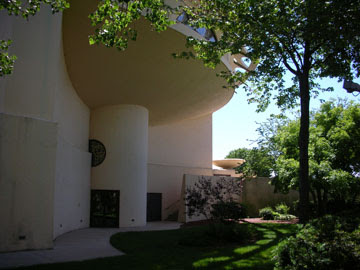

While in California I visited the aforementioned Hollyhock House in Hollywood.

I took the ferry to San Rafael from San Francisco, past San Quentin State Prison, to see the Marin County Civic Center (1957). There was no official tour and visitors can go anywhere they like both inside and outside the building. It is truly spectacular. Some of the furniture was made by San Quentin inmates.

In San Francisco, I went to the V.C. Morris Gift Shop (1948). It has an interior spiral slope which is a sort of mini version of the one in the Guggenheim. It's an African artifacts gallery and bookshop.

In 2002, I made a journey by Greyhound bus from Toronto to Madison making stopovers in Detroit and Chicago to see art, architecture and baseball. While in Chicago, I took two walking tours. In the morning I saw historic architecture and in the afternoon modern architecture. The Rookery Building foyer (1905) which Wright remodelled, was on the tour.

I visited the Guggenheim Museum in spring 2006, when I was in New York. I'd been there before, but not when David Smith's sculptures were on show. They provided suitable ornamentation for the giant swirling ramp, which is the focal point of the museum.

Unlike Henry Michel, I can't claim even to be an "expert amateur" when it comes to Wright and his work, but I am deeply addicted to his buildings. Next, I plan to see Mill Run (1935-1948) in Pennsylvania, which is said to be Wright's organic masterpiece because it is built over a waterfall ~


Pictures to come of the other sites once I've scanned them.