Showing posts with label England. Show all posts
Showing posts with label England. Show all posts


May 7, 2012
I wrote this obituary for my aunt

TAGG, Lily (NEE FOREMAN)
Passed away May 1, 2012 age 90 in Maidstone Hospital after a brief illness.
Lily, born in Cranbrook, Kent, on August 9, 1921, lived in Staplehurst, then Maidstone where she was working as a “clippy” bus conductor during the Second World War when she met her future husband Joe Parkes, a coal salesman.
Moving to London in 1947, she worked as a housemaid, marrying Joe in 1950. Lily later became a telephonist and supervisor with the General Post Office, a career carried to Maidstone from London's Bayswater and Sloane Square exchanges, after she and Joe moved in 1965 to nearby Barming.
In 1978, almost 10 years after Joe's death from tuberculosis in 1969, Lily married his cousin Rob Tagg with whom she enjoyed four years before being widowed a second time.
Throughout her careers and after retirement in 1981, dear Lily created happiness and often helpfulness for colleagues, neighbours, friends and kin, including her late brother Fred Foreman of Maidstone.
She enjoyed driving in the Kent countryside, walking her dog Prince by the River Medway and dog-sitting for neighbours in Barming's Beverley Road Estate.
Amid the deep sadness at her passing, Lily shall be ever warmly remembered by many who knew her.
A funeral service will be held on Thursday, May 17, 2012 at 12:30pm at Vinters Park Crematorium in Maidstone followed by interment at St Margaret of Antioch, Barming parish church, at a later date.
Donations can be made by cheque in Lily's memory to Guide Dogs for the Blind c/o Family Funeral Service, 6 Marlborough Parade, Beverley Road, Barming, Maidstone, Kent, ME16 9JN or directly to the organisation.
Family flowers only, please.
Apr 13, 2012
New World v Olde Worlde: stranger in a familiar land

This post was commissioned by @DougDowen and originally appeared on his blog The Common Voice
If my calculations are correct, I’ve moved 31 times.
I’ve moved as a resident between Britain and Canada four times, and between the United States and Canada twice.
I’ve lived in 10 different places in Toronto, where I was born. I’ve also lived in various places in Ottawa, Stratford and Gananoque, Ontario, and Halifax, Nova Scotia.
In each of Washington, D.C., and Edmonton, Alberta, I had only one abode.
I consider myself fortunate to have moved about so much, although each move has resulted in both gains and losses.
Without a doubt, returning to Britain in 2008, where I lived as a child, has been the most disorienting move of all.
For some reason, almost everyone assumes I’m an American citizen.
LONDON CALLING
The weirdest thing about moving to London has been that I’ve felt more alien in this familiar place than in any of the unfamiliar places to which I’ve moved in the past.
I had been with Reuters for three years when I applied for a position in 2008 and was transferred to work on the online desk in London.
My earliest memories are here.
My mother is from a small village called Grayshott on the Surrey-Hampshire border. As a child, I spent a lot of time with my grandparents in their home, Bidston, on Crossways Road.
To me -- a person without a proper root in any particular geographic location -- Britain is a home country, but no one I meet realizes it because of my Canadian accent.
It’s perhaps not so surprising that almost everyone in Britain assumes I’m from “America” because of the similarities between certain U.S. and Canadian English-language accents.
What seems truly funny is the disdainful treatment I receive due to my supposed “American-ness” by the citizens of a country so economically, politically and militarily tied to the United States.
ENGLISH, CANADIAN, AMERICAN ROOTS
My mother is English, her parents were English and Welsh, and so on up the generations, as far back as I know.
My father is Canadian.
My father’s father was born just outside Boston in Melrose, Massachusetts, but lived most of his life in Canada.
During the First World War, my grandfather served from 1915 to 1918 in Horsham, England, and on the battlefields of France as an artilleryman with the 2nd Canadian Siege Battery, which was later incorporated into the 98th Canadian Siege Battery.
His parents, my great-grandparents, were Canadian.
Their ancestors, who emigrated to New Brunswick, Canada, in 1813, were also English, from the region now known as Cumbria.
We can trace my Canadian grandmother’s ancestral presence in the New World -- to New England in the United States -- as far back as the 1700s.
As Nickersons, Armours, and Sowerbys, we think they were Scottish and English.
MYSTERIOUS FOREIGNER
Of course, sounding like a foreigner in a society which places a premium on accents -- see George Bernard Shaw’s 1912 play “Pygmalion” in which the upper class Henry Higgins teaches Eliza Doolittle, a Cockney flower girl, to speak “proper” English -- can have its benefits.
Very few strangers can “pigeonhole” me accurately.
There’s a certain amount of freedom in being an alienated, passport-carrying, classless stranger in a familiar land.
The
opinions and viewpoints expressed are those of the author, and do not
reflect the opinions and viewpoints of her employer, nor any other
professional entity with which she may be affiliated.
Jul 5, 2011
Scadding cabin

John Scadding was manager of the Devonshire estate of the first lieutenant governor of Ontario, John Graves Simcoe.
He moved to Canada in 1792 and came to York (Toronto) with Simcoe in 1793. He was granted 250 acres and built this cabin.
He lived in England from 1796 to 1818, returning to Canada to sell the cabin.
Sent from my BlackBerry® wireless device
May 15, 2011
English pancakes, or Shrove Tuesday

I sent this to an American I know from Twitter who wanted the recipe for English pancakes -- shortly after March 8 - Shrove Tuesday.
I don't have my mother's recipe in London, so I use a recipe from a Gary Rhodes cookbook my sister gave me a few years ago titled "New British Classics".
My mother is English and my father Canadian. They met in London and then moved back and forth between the UK and Canada several times as well as the United States.
My mother started a tradition of serving my sister and me English pancakes when we were children, but later in life hated making them.
She would often not tell us when it was Pancake Day, so she wouldn't be coaxed into making them.
She much prefers to make Canadian pancakes, which are far simpler.

Although the Rhodes recipe below does not specify, I have always eaten English pancakes, which are like crepes, with white granulated sugar and either freshly squeezed lemon juice or orange juice.

I have always preferred orange juice to lemon as I find it too sour.
My mother taught us to sprinkle sugar over the pancake, then drizzle juice over it, roll it up and sprinkle a bit more sugar and juice on top.
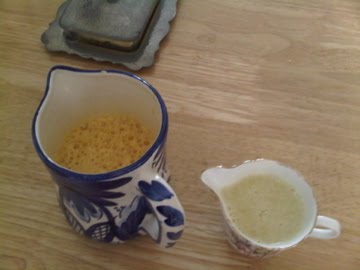
These are tedious to make as you have to put the batter on the pan and then tilt it around to ensure the batter spreads out thinly on the pan.
After pouring the batter, I wait for until the edges are cooked through and peeling away a bit from the pan. Then I shake the pan so the pancake loosens. Once it is getting cooked through I flip the pancake on the pan rather than using a spatula to turn it.
For maximum efficiency and to cook these up as quickly as possible, I would recommend using two frying pans. Otherwise it seems to take forever standing at the stove.
I hope you enjoy these if you make them.
Gary Rhodes
New British Classics
Home-made Pancakes
Pancakes were among the very early enriched breads cooked on the griddle and have become one of our favourite breakfast and afternoon tea foods. They have a long-standing yearly association with Shrove Tuesday, otherwise known as Pancake Day, which is when all the eggs must be used up before Lent.
Pancakes are a Sunday treat in our house, with my sons and me whisking away making the batter.
And then I cook the pancakes, while they eat them: I'm making a mistake somewhere! But they are so easy to make and with a dribbling of golden syrup, just delicious. They could also be served with honey, jam or ice cream. In a savoury sense, they can be filled with ratatouille, fish stew, mussels, chicken and so on.
This quantity will make 16-24 pancakes, depending on the size of pan used. It is best to use a 20 cm (8 in) or 15 cm (6 in) frying pan.
- 225 g (8 oz) plain flour (all purpose in North America)
- Pinch of salt
- 2 eggs
- 600 ml (1 pint) milk
- 50 g (2 oz) unsalted butter, melted
- Vegetable oil, for frying
Sift the flour and salt into a bowl. Whisk the eggs and the milk into the flour. Add the melted butter and whisk into the mix. At this stage, the mix can be used for sweet or savoury pancakes.
For a stronger savoury flavour, chopped fresh parsley or mixed herbs can also be added.
To cook the pancakes, pre-heat the frying pan. Lightly oil the pan and pour in some the mixture, making sure the pan has only a thin layer of mix by tilting and rotating the pan to make the batter spread out.
Cook for 30-40 seconds, until golden brown. Turn the pancake over and cook for a further 20-30 seconds.
The pancake is now cooked. Keep warm between squares of greaseproof paper, while you cook the remainder. Two or three pancakes per portion should be plenty.
If made well in advance, the pancakes can be microwaved for 30-40 seconds to re-heat.
Jan 22, 2010
Chipmonks get creative

This origami budgie was made by @maxxmonkey's chipmonks. It is a copy of the budgie I found in the garden a few years ago. It is very well done and I wanted to share it with my faithful readers :)

Jun 21, 2009
Bird's eye views

I know I am breaking a cardinal rule of photography here by taking a picture with a window in the background, but so be it. Squint. A friend gave me the mint plant on the windowsill. It is in a pot given to me by a cousin. I bought the white orchid on Great Suffolk Street and the violet one in Borough Market. The plate I bought in Hollywood. The lamp I bought on The Cut. The beer tankard is a leaving gift from my colleagues in Toronto.

Here is a longer view of it all.

Kitchen table with picture taken from train of mountains and lake in Alberta.

A shot of the shelving unit I built. The vase is from Mum's friend Marie. She bought it for me when I went to visit her in Grayshott.


Jun 8, 2009
Secret garden


These pictures below are of the Tate Modern Community Garden, where nearby residents can go if they become members. There is no charge to join.

Often there is no one else in the garden when I visit except for the cat pictured above, the duck, the doves and the fish.


Looks like Mr MacGregor was in the garden today because his wheelbarrow is out.


Cafe supremo

A colleague gave me this espresso maker, which is fantastic because otherwise I would have had to pay a minimum of 50 pounds at John Lewis to buy one.
Jun 7, 2009
Getting organized

For those of you who've been wondering, I've been getting my flat in London organized. Yes, I am still coping with many British "terms & conditions", but I have made lots of progress. The major remaining hurdle is to deal with the taxes.
Here are some pictures of things in my flat.
The picture above shows some of the toys I have knit.


Mar 14, 2009
Bard's birthplace

William Shakespeare's birthplace in Stratford-Upon-Avon in December.


Was told off for taking the picture of the inside. Wished I had chosen something else to take a picture of afterwards.

Thought about working at the Stratford Festival in Ontario while I was there.

Subscribe to:
Posts (Atom)


 Posts
Posts


