I arrived at about noon in Toronto from London and have been struggling against fatigue to stay awake ever since, failed and crashed for two hours late this afternoon.
Flew to Toronto via Air Canada on a Boeing 767.
During take off water started dripping on my arm and leg apparently from the luggage container overhead. I had no idea what it was.
The woman sitting next to me pushed the call button for the flight attendent, and I waved to her from my seat. She could not come over because we were required to have our seat belts on during lift off.
She didn't come over once the seatbelt sign was off, so I went to the rear of the cabin and asked another flight attendent for help.
Before take off I was lingering at the back of the plane and this same flight attendent breezed by saying "What a frigging nightmare".
When I mentioned we had rung the bell and required help, she got defensive and said they couldn't come over during take off. This however didn't explain why no one came over afterwards.
She came over to see what had happened and checked inside the luggage container. When she found nothing, she said it must have been condensation and handed me a wad of paper towels. No apology and very surly attitude.
I followed her to the back of the plane and told her I didn't like her approach,
The other flight attendent was there and she apologized for not coming over after the seatbelt sign went off, saying that she thought it was just a matter of me wanting to get something out of the overhead luggage container during lift off!
The flight attendent who had come over to check out the problem said: You need to relax.
Bizarre and unappreciated given the price of the ticket.
Showing posts with label Travel. Show all posts
Showing posts with label Travel. Show all posts
Dec 16, 2010
Sep 7, 2009
Not a tribute
Strange couple of months.

First Fred died of cancer in Maidstone.


Back to Canada
Family stuff

Back to UK
Work
Aggro
Travel
Family stuff

Back to UK
Work
Aggro
Travel
Dec 27, 2008
Boxing Day hunt, Broadway
In which the Boxing Day Hunt in Broadway is observed. The video begins with a man collecting "money for the hounds" in a bucket. It continues with a second man collecting "money for the air ambulance" in a bucket. The hounds come next, followed by the hunters, their children and some cyclists.
Nov 20, 2008
Oct 12, 2008
Perspective

I think mice are rather nice;
Their tails are long, their faces small;
They haven't any chins at all.
Their ears are pink, their teeth are white,
They run about the house at night;
They nibble things they shouldn't touch,
and, no one seems to like them much,
but, I think mice are rather nice.
Rose Fyleman
Oct 1, 2008
Retracing Mum's routes
These are some London congestion charge "Cs" painted on the road. I took pictures as we roamed a route familiar to my mother who used to live and work in London.


My mother used to work for Bill Linnit, a theatre producer, in this building. The Linnits moved to the flat from Barton Street around the corner.
 This was once the home of Lawrence of Arabia.
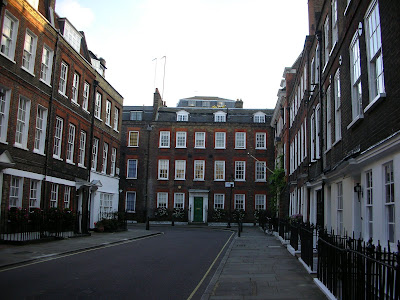
John Gielgud lived at the end of Barton in the house with the green door.

Number 11 is where my mother worked for the Linnits before they moved around the corner. She had a bedroom at the back of the house.

Lord Reith also lived on Barton Street, which is behind the Dean's Yard at Westminster Cathedral.

As we wandered, we encountered these signs.


Big Ben with the London Eye in the background.

Whitehall protest.


My mother used to work for Bill Linnit, a theatre producer, in this building. The Linnits moved to the flat from Barton Street around the corner.
 This was once the home of Lawrence of Arabia.
John Gielgud lived at the end of Barton in the house with the green door.

Number 11 is where my mother worked for the Linnits before they moved around the corner. She had a bedroom at the back of the house.

Lord Reith also lived on Barton Street, which is behind the Dean's Yard at Westminster Cathedral.

As we wandered, we encountered these signs.


Big Ben with the London Eye in the background.

Whitehall protest.

Oct 18, 2007


Apr 5, 2007
Account of the Battle of Vimy Ridge

Easter, 1917
From World War I Pocket Diary
Canadian Artilleryman Harry Whitfield Mollins

From World War I Pocket Diary
Canadian Artilleryman Harry Whitfield Mollins

Hometown Moncton N.B., served 1915-1918, originally with the 2nd Siege Battery, formed at Charlottetown, P.E.I., later incorporated into the 98th Canadian Siege Battery.
Born November 11, 1895, Melrose, Mass. (In his teens, joined his parents’ return to their original home in Moncton.) Died December 8, 1945, in Toronto.
Born November 11, 1895, Melrose, Mass. (In his teens, joined his parents’ return to their original home in Moncton.) Died December 8, 1945, in Toronto.

Thursday, April 5 Weather: Fine
Carrying ammunition to the No. 4 gun all day. We are getting a reserve store ready for the “strafe” which “comes off” in a few days. Aeroplanes very active today.Good Friday, April 6 Weather: Rain
On duty at the guns all day. Did considerable firing. Mailed letters to Walter Ryder & Grandma and Grandpa Duncan. A “Fritz” plane brought down one of ours, in flames, this evening. He then came right over toward our battery after another, but was driven off by our planes.Saturday, April 7 Weather: Fine
On ammunition fatigues all day. Did considerable firing. Had to take a count of all the shells et cetera. A “Fritz” plane brought down one of our observation balloons this morning. It came down in flames. Letter from Mrs. Blackmore this evening & Easter cards from Mrs. Morton and Marcella Mollins of Moncton. On the guns all night. Fired 123 rounds.Easter Sunday, April 8 Weather: Fine
Easter Sunday and a beautiful day. Nothing of importance happened. A few German shells dropped around the position. Our infantry goes over tomorrow in an attempt to capture Vimy Ridge. Expect it will be a big day.Easter Monday, April 9 Weather: Fine
On fatigues all day. This is the day of the big “strafe.” There was a heavy bombardment at 5:30 a.m. and the infantry went over from Vimy Ridge to the right. Large numbers of prisoners and guns were taken. Vimy Ridge fell into our hands. Parties of prisoners passed our position all day. All seemed glad to have been captured. Our casualties were not very heavy. Nice parcel from mother this evening containing fountain pen, cake, candy, etc.Tuesday, April 10 Weather: Fine
On the guns all day. Very quiet this morning. We started firing about 11:30 A.M. and from then till six fired 215 rounds. The infantry went over again this afternoon & gained their objective. More prisoners & guns were taken. The reports are very encouraging, in fact, too much so. However, everybody is very happy over the good results. “Fritz” put quite a few shells quite near our position today.USA has entered the war on the side of the Allies.
Wednesday, April 11 Weather: Rain
On ammunition fatigues today. Had an easy day. “Fritz” shelled quite heavily today. Everything is still going favorably for us. Everyone is jubilant. We expect to be moving forward in a few days. On the guns all night. No firing up till twelve o’clock. Snowing very heavily this evening. “Fritz” shelled in this vicinity.An ammunition dump of the No. 2 “Heavies” was blown up.
Thursday. April 12 Weather: Snow & Rain
We were called out at 3:30 A.M. and fired twenty rounds. At 5 A.M. there was a twenty minutes “strafe.” It was snowing and blowing something awful & very cold. Our infantry went over & gained their objective, and captured 600 prisoners. Off duty all day. It is reported this evening that 12,000 prisoners have been taken south of Arras, also 400 guns.USA has declared war on Germany and severed relations with Austria. It is rumored the Argentine & Brazil are at war with Germany & have seized all Hun shipping in their ports.
Friday, April 13 Weather: Fine & warm
Easy day. A very interesting report of operations to date was posted this morning. Wancourt & Heeinel have been captured. The Hindenberg Line has been cleared 2,000 yds. south of Cojeul. The 1st Army (which includes the Canadians) has captured 4,000 prisoners, 33 guns, 112 Machine guns & 40 Trench Mortars. The Third Army on our right has captured 7,526 prisoners, 126 guns, 113 Machine guns, 44 Trench Mortars. The guns captured include 8”, 5.9”, 4.5” & field guns. “Fritz” has retired and our infantry is after him. Got orders to move this evening.
The following morning, the Canadian artillery unit began moving a few kilometres to a battlefront near the villages of Souchez and Carency, where, on Monday, April 16, the Canadian gunners re-engaged German artillery. The diary says:
"While we were firing the Huns burst two shrapnel [shells] right over the gun. No one was hurt. Spent the night in an old cellar, which we cleaned out. We dug up two skeletons in the debris.”
That evening, the diary notes, he received another Easter greeting card from home. It was to be almost 19 months before the war ended—on Harry Mollins’s 23rd birthday.
------------
Back home in Moncton, he worked for a time as manager of the furniture section of the local Eaton’s department store and polished his reputation as a baritone soloist in the city’s Baptist church and other choirs.
In the 1920s, he married Vera Grace Nickerson, gained B.A. and B.D. degrees at Acadia University in Wolfville, N.S., and became minister of the Baptist church in nearby Windsor, N.S.
He later served ministries in Ottawa (Fourth Avenue Baptist Church, 1933-1939) and in Brantford, Ont. (Park Baptist Church, 1939-1945, where his first sermon was given on the first day of World War II, Sunday, September 3, 1939) before the final 10 weeks of his life in Toronto (College Street Baptist Church) after the end of World War II.
Compiled by Carl Mollins, son of Harry, 5-4-07


Apr 2, 2007
Waterfowl parade to the Avon River

Most of the birds that paraded from the Stratford, Ont. arena along Lakeshore Drive and into the Avon River on Sunday are said to be the descendants of a swan couple given by the Queen to Ottawa in 1967.

Their royal lineage was evident in the regal way they marched with heads held high past several hundred spectators lining the route to the water.


The waterfowl were accompanied on their journey by the bagpipes and drums of the Perth County Pipe Band.

The 22 white swans in the parade outnumbered two black swans, a bar-headed goose, two Chinese geese and two Canadian geese.
It was unclear why one white swan was already swimming on the river before the parade. No one seemed to know if it had arrived from elsewhere or if it had somehow escaped.

The oldest swan, Charles I, is 22 years old, the Stratford Beacon Herald newspaper reported in its Monday edition.
Once the birds got into the water they seemed uncertain about the best way to proceed.

They swam straight across to the other side of the river pursued by a television camera crew in a dingy.

After they got to the other side, they turned upstream and some of the swans spread their wings and flew for a few minutes.
Bob Miller, formerly honorary keeper of the Stratford swans, generally accompanies the birds each year on their march to the river from the arena where they spend the winter.

However, Miller died in February at 90, so this year the swans were led by his widow Barb, children Carol, Wendy and Bob Miller Jr. and June Kinsman, who, the Beacon Herald reported, "over the past few years has been keenly interested in the care of the swans."
The clean up afterwards was surprisingly efficient.


People seemed to evaporate quickly from the riverbanks, leaving the swans to adjust to life on the river again. There were some nasty squabbles among the species, but for the most part the birds seemed content to swim, eat and court.


The ducks, who fend for themselves year round, seemed somewhat out of sorts.

Feb 22, 2007
Organic encounters with FLW

I was guided through Frank Lloyd Wright's Hollyhock House in Los Angeles by a man who in his childhood lived near Oak Park, Illinois, where many of Wright's early structures were built.
That man, Henry Michel, writes in the forward of his self-published book "Basic Frank Lloyd Wright" (1999) that he is an "expert amateur" who has written two other books on Wright's work.
Whether fact or fiction, Michel's tour of Hollyhock House and his tale of Aline Barnsdall, the theatre producer who financed it, was memorable. He hustled through the gardens and rooms chastising tourists who lingered too long or peered into off-limit areas.
I was travelling alone. The others on the tour were similar to those I've seen at other Wright sites: mainly down-to-earth American enthusiasts in untucked shirts, shorts, tube socks and sneakers.
There were a couple of architects who childishly violated all of Michel's rules by waiting until he had marched off to the next gathering point before darting up forbidden stairways or surreptitiously snapping pictures.
Although I wasn't compelled to join them in their anarchist acts, I understood their need to see and capture all the desolate magic of that crumbling place.
Each of the 12 Wright sites I've visited since 2002 has a very distinctive flavor beyond the expected architectural idiosyncrasies.
UTOPIAN IDEALS
When Wright proclaimed a Declaration of Independence from architectural tradition in 1896, he was articulating the utopian vision that would inform his work throughout his career.
Wright’s declaration proposed a political and aesthetic ideology geared toward developing a style of architecture he hoped would transform and improve U.S. society.
A central tenet of Wright's philosophy was that traditional European architecture contained irrelevant ornamental design elements that should be set aside, or reinterpreted, to generate a more organic architecture.
Wright’s ideas for a new style of architecture emerged under the influence of technological changes that were transforming the U.S. into an industrialized and urban society at the turn of the last century. Wright was also influenced by creative European movements such as the Arts and Crafts and International Style.
About half of the 1,000 buildings he designed between 1887 and 1959 were constructed throughout the U.S., Canada and Japan, according to Arlene Sanderson's "Wright Sites" (Princeton, 2001).
Wright believed there was a need to create an architecture unique to the U.S. that would serve to enhance humanity in its surrounding landscape.
He opposed the use of ornament found in traditional architecture exported from Europe to the U.S.—terming it degenerate—and spent his career in pursuit of what he called organic architecture.
In "An Organic Architecture" (1939), Wright said he wanted to meld together form, structure and space in such a way as to create complete entities he believed would transform and uplift society in a manner suited to the liberal idealism he perceived as characteristic of the U.S.
He sought to create structures that would be unified with their surrounding landscape and to incorporate ornamentation into overall design so that they would become enclosed organisms.
DEPARTURE FROM TRADITION
As Wright eschewed what he called the false purpose of traditional ornament, he reinterpreted it. He believed his methods would improve the human condition at large.

In "An Organic Architecture", Wright commented on Michelangelo’s dome on St. Peter's Basilica (1506-1615) in Rome and Christopher Wren’s copycat dome on St. Paul’s Cathedral (1675-1708) in London expressing his belief that traditional architectural ornament serves only to lend a form of false authority to a given structure.
"I declare, the time is here for architecture to recognize its own nature, to realize the fact that it is out of life itself for life as it is now lived, a humane and therefore an intensely human thing; it must again become the most human of all the expressions of human nature," he wrote.
"The 'Classic' [architecture] was more a mask for life to wear than an expression of life itself ... Modern architecture—let us now say organic architecture—is a natural architecture—the architecture of nature, for Nature."
Wright’s efforts to use exterior ornament solely for a functional purpose and to mesh with the natural landscape are reflected in his Prairie period in the early part of the 20th century.
The Prairie houses are built of natural materials and have low roofs and stained-glass windows. They are also characterized by a central garden. The surrounding home creates an enclosure around the garden, which establishes an organic core—a rustic predecessor to Wright’s more streamlined futurist work.
Wright’s later tendency toward designing sleek, science-fiction like, self-contained organic entities emerges in his Usonian period of the 1930s. His utopian aspirations led him to design such futuristic buildings as the Marin County Civic Center and the Solomon R. Guggenheim Museum (1956). In those buildings ornamentation becomes formalized as a part of the overall structure.
ENCOUNTERING WRIGHT

In 2002, I drove from Madison, Wisconsin, to Taliesin (rebuilt 1925) in Spring Green where Wright lived. I toured the Hillside Studio and theatre. Hooked, I returned the next day to tour the house. There was no admission charge to visit the church and cemetery where Wright is buried, but the cost to tour the other buildings was very high.
On that trip I also saw Monona Terrace (1995, based on 1959 design) in Madison.

When I returned to Madison in June 2006, for a wedding, I stayed at the Monona Terrace Hilton so I could overlook the terrace and the lake. It serves as a giant piazza for Madison residents.
The uncle of my newlywed friends took me on a tour of the Unitarian Meeting House (1947), which was free to the public.


He drove me to the Gilmore House (1908) but it is privately owned and we couldn't go inside.


En route to Madison from Milwaukee by car last year, I made a special trip to the S.C. Johnson Administration Building (1936) in Racine. I got lost several times on the way because I took local roads in order to avoid the major highway. I wanted to drive next to the lake.

There was no charge for the tour of the Johnson building, but visitors have to book ahead. Photography is banned on the grounds and there is an obligatory 20-minute promotional talk on S.C. Johnson's company history and cleaning products.

The so-called Great Workroom, with its ingenious upside-down inverted mushroom-like pillars is still in use, so visitors are corralled in a specific area of the room. The research tower is off limits. It is used for storage because it doesn't meet modern-day safety standards. If you click on the diagram below you can see the detail.

On the drive back from Madison I got lost trying to find the Annunciation Greek Orthodox Church (1956) in Milwaukee.

I found myself trapped in a dystopian suburban network of roads driving in circles or figure eights for about an hour. I am not sure if my map was outdated. There were no human beings.
It was more frustrating than driving down the curvy Pacific Coast Highway from San Francisco to Los Angeles by myself in September 2005, but not as scary. That was a white-knuckle drive.
The Greek Orthodox Church does not allow visitors inside unless there are 15 people all clamoring to get in at once so I sated my curiosity by peering in windows and wandering around outside.

While in California I visited the aforementioned Hollyhock House in Hollywood.
I took the ferry to San Rafael from San Francisco, past San Quentin State Prison, to see the Marin County Civic Center (1957). There was no official tour and visitors can go anywhere they like both inside and outside the building. It is truly spectacular. Some of the furniture was made by San Quentin inmates.
In San Francisco, I went to the V.C. Morris Gift Shop (1948). It has an interior spiral slope which is a sort of mini version of the one in the Guggenheim. It's an African artifacts gallery and bookshop.
In 2002, I made a journey by Greyhound bus from Toronto to Madison making stopovers in Detroit and Chicago to see art, architecture and baseball. While in Chicago, I took two walking tours. In the morning I saw historic architecture and in the afternoon modern architecture. The Rookery Building foyer (1905) which Wright remodelled, was on the tour.
I visited the Guggenheim Museum in spring 2006, when I was in New York. I'd been there before, but not when David Smith's sculptures were on show. They provided suitable ornamentation for the giant swirling ramp, which is the focal point of the museum.
Unlike Henry Michel, I can't claim even to be an "expert amateur" when it comes to Wright and his work, but I am deeply addicted to his buildings. Next, I plan to see Mill Run (1935-1948) in Pennsylvania, which is said to be Wright's organic masterpiece because it is built over a waterfall ~

Pictures to come of the other sites once I've scanned them.
Subscribe to:
Posts (Atom)


 Posts
Posts


