Showing posts with label Tribute. Show all posts

Sep 7, 2009

Not a tribute

Strange couple of months.


First Fred died of cancer in Maidstone.


Then Ant died of cancer in Toronto.


Back to Canada
Family stuff


Back to UK
Work
Aggro
Travel

Feb 19, 2008

End of an era


A big day.

Fidel Castro retired and the Thomson takeover of Reuters was approved in the U.S. and the EU.

Oct 15, 2007

Ophelia, cemeteries & suicide


A friend of mine killed herself a few weeks ago. I knew her for about 20 years. We met at the Art Gallery of Ontario where she organized special events and functions. I was a waitress in the member's lounge.


The day I found out she'd killed herself, I saw this graffiti in Philosopher's Walk near the Royal Ontario Museum. I wondered how many people would share this sentiment.


She would visit the member's lounge for a glass of wine after she finished work on Wednesdays--the one day of the week that the gallery stayed open late. We liked each other, but we didn't socialize.

We were both very good pals of a talented, yet troubled, artist friend who killed himself in May 2005. I also met him during the two years or so when I worked at the gallery. He was a waiter in the restaurant and a gifted jeweller and artist.

The two spent a lot of time together. She was an excellent friend to him.

She was laid off after 25 years or so of working at the gallery. He killed himself on her last day on the job.

He was quite ill physically and was suffering from depression. He was an alcoholic and abused drugs. He threw himself on the subway tracks at the Queen Street station after checking himself out of St. Michael's Hospital.

The last time I saw him he was so high that he could barely speak. We went to see the film "Ray" at the Bloor Cinema and he passed out and slept through the entire movie. He phoned me at about 1:30 a.m. to apologize.

We tried to meet again a couple of times, but he never showed up.

He had tried previously to kill himself. I had intervened and taken him to the hospital on one occasion. I had also helped get him out of jail when he got into a mess while holidaying in St. Eustatius once.

After he killed himself, she and I got together from time to time.

I hadn’t heard from her for quite a while, but I sent an email to her husband about a week before she hung herself on her back deck.

Apparently, she left no note, but had been suffering from insomnia and anxiety.

The memorial was held while I was away in England.

While I was in London I saw an exhibition of the work of John Everett Millais at the Tate Britain. His romanticized image of Ophelia after she killed herself is shown below.


These are not the first friends I've known who have killed themselves.

A long time ago, when I lived in Ottawa and was in Grade 8, a friend killed himself while sniffing glue.

CEMETERY OUTSIDE ALL SAINTS CHURCH

This church in Maidstone was built in 1395, but the site has had a church on it since 650. I am not sure of the age of these tombstones in the pictures because the dates are worn off.


Construction on St. Mary's Church in Chiddingstone began in the 13th Century.


CEMETERY NEAR ORANGEVILLE

I went to this cemetery in May of this year. It is outside a village near Orangeville, Ont.


Apr 5, 2007

Account of the Battle of Vimy Ridge


Easter, 1917
From World War I Pocket Diary
Canadian Artilleryman Harry Whitfield Mollins


Hometown Moncton N.B., served 1915-1918, originally with the 2nd Siege Battery, formed at Charlottetown, P.E.I., later incorporated into the 98th Canadian Siege Battery.

Born November 11, 1895, Melrose, Mass. (In his teens, joined his parents’ return to their original home in Moncton.) Died December 8, 1945, in Toronto.


Thursday, April 5 Weather: Fine
Carrying ammunition to the No. 4 gun all day. We are getting a reserve store ready for the “strafe” which “comes off” in a few days. Aeroplanes very active today.

Good Friday, April 6 Weather: Rain
On duty at the guns all day. Did considerable firing. Mailed letters to Walter Ryder & Grandma and Grandpa Duncan. A “Fritz” plane brought down one of ours, in flames, this evening. He then came right over toward our battery after another, but was driven off by our planes.

Saturday, April 7 Weather: Fine
On ammunition fatigues all day. Did considerable firing. Had to take a count of all the shells et cetera. A “Fritz” plane brought down one of our observation balloons this morning. It came down in flames. Letter from Mrs. Blackmore this evening & Easter cards from Mrs. Morton and Marcella Mollins of Moncton. On the guns all night. Fired 123 rounds.

Easter Sunday, April 8 Weather: Fine
Easter Sunday and a beautiful day. Nothing of importance happened. A few German shells dropped around the position. Our infantry goes over tomorrow in an attempt to capture Vimy Ridge. Expect it will be a big day.

Easter Monday, April 9 Weather: Fine
On fatigues all day. This is the day of the big “strafe.” There was a heavy bombardment at 5:30 a.m. and the infantry went over from Vimy Ridge to the right. Large numbers of prisoners and guns were taken. Vimy Ridge fell into our hands. Parties of prisoners passed our position all day. All seemed glad to have been captured. Our casualties were not very heavy. Nice parcel from mother this evening containing fountain pen, cake, candy, etc.

Tuesday, April 10 Weather: Fine
On the guns all day. Very quiet this morning. We started firing about 11:30 A.M. and from then till six fired 215 rounds. The infantry went over again this afternoon & gained their objective. More prisoners & guns were taken. The reports are very encouraging, in fact, too much so. However, everybody is very happy over the good results. “Fritz” put quite a few shells quite near our position today.
USA has entered the war on the side of the Allies.

Wednesday, April 11 Weather: Rain
On ammunition fatigues today. Had an easy day. “Fritz” shelled quite heavily today. Everything is still going favorably for us. Everyone is jubilant. We expect to be moving forward in a few days. On the guns all night. No firing up till twelve o’clock. Snowing very heavily this evening. “Fritz” shelled in this vicinity.
An ammunition dump of the No. 2 “Heavies” was blown up.

Thursday. April 12 Weather: Snow & Rain
We were called out at 3:30 A.M. and fired twenty rounds. At 5 A.M. there was a twenty minutes “strafe.” It was snowing and blowing something awful & very cold. Our infantry went over & gained their objective, and captured 600 prisoners. Off duty all day. It is reported this evening that 12,000 prisoners have been taken south of Arras, also 400 guns.
USA has declared war on Germany and severed relations with Austria. It is rumored the Argentine & Brazil are at war with Germany & have seized all Hun shipping in their ports.

Friday, April 13 Weather: Fine & warm
Easy day. A very interesting report of operations to date was posted this morning. Wancourt & Heeinel have been captured. The Hindenberg Line has been cleared 2,000 yds. south of Cojeul. The 1st Army (which includes the Canadians) has captured 4,000 prisoners, 33 guns, 112 Machine guns & 40 Trench Mortars. The Third Army on our right has captured 7,526 prisoners, 126 guns, 113 Machine guns, 44 Trench Mortars. The guns captured include 8”, 5.9”, 4.5” & field guns. “Fritz” has retired and our infantry is after him. Got orders to move this evening.


The following morning, the Canadian artillery unit began moving a few kilometres to a battlefront near the villages of Souchez and Carency, where, on Monday, April 16, the Canadian gunners re-engaged German artillery. The diary says:

"While we were firing the Huns burst two shrapnel [shells] right over the gun. No one was hurt. Spent the night in an old cellar, which we cleaned out. We dug up two skeletons in the debris.”

That evening, the diary notes, he received another Easter greeting card from home. It was to be almost 19 months before the war ended—on Harry Mollins’s 23rd birthday.


------------

Back home in Moncton, he worked for a time as manager of the furniture section of the local Eaton’s department store and polished his reputation as a baritone soloist in the city’s Baptist church and other choirs.

In the 1920s, he married Vera Grace Nickerson, gained B.A. and B.D. degrees at Acadia University in Wolfville, N.S., and became minister of the Baptist church in nearby Windsor, N.S.

He later served ministries in Ottawa (Fourth Avenue Baptist Church, 1933-1939) and in Brantford, Ont. (Park Baptist Church, 1939-1945, where his first sermon was given on the first day of World War II, Sunday, September 3, 1939) before the final 10 weeks of his life in Toronto (College Street Baptist Church) after the end of World War II.

Compiled by Carl Mollins, son of Harry, 5-4-07

Feb 17, 2007

A right to learn for learning's sake


By Carl Mollins

The basic mood and spirit that coloured the 70-plus years of Walter Whitfield Mollins, and shaped the gifts of living he spread to so many others, began on the day of his birth in Ottawa.

This writer, his brother, remembers that day near the end of May--a Friday, May 29, 1936, a few weeks before my fifth birthday. Our father came home from the hospital, where our mother had gone for reasons I really didn’t understand. He skipped up the stairs, singing in his musical baritone the announcement to me and my two older sisters that a baby boy had joined the family.

It was pure happiness.

Walt became the life of the family. As well, in reversal of the customary case of the kid brother copying his big brother, Walt in many ways was a model for me.

It was noted, for one thing, that we shared a mutual aversion to shaving. Even in that, Walt’s beard sparked the happier reactions: Folk sometimes compared me to Karl Marx, whereas youngsters often took Walt for Santa Claus.

His sense of humour, pursuit of happiness, his encouragement of that spirit in others, persisted throughout his life and into its final days.

PLAYFUL CHILD BECOMES CULTURED ADULT

His positive mind and manner persevered despite his struggle against the depressive diabetes that struck in early childhood and governed him physically ever after.

In fact, with the diabetic’s need to maintain a balance among daily intakes of insulin and food with exercise, he indulged at an early age in fun and games as a means of burning off excess calories. Many were the laughter-fuelled sessions of skip-rope or hopscotch, of climbing a slippery poplar or, in winter, playing two-person hockey on the home-made backyard rink.


The fun and games contributed in turn to Walter’s active life of happily “doing things,” be it at the piano or with his violin, his paintbrush portraying a landscape, his pen composing a poem, or singing in choirs that toured at home and abroad. Then there was helping Ruffles the dog through a tricks routine.

A good part of the rest of his waking hours would be engaged in fundraising campaigns for charities and performing volunteer services to the community. The most important part of that included his active assistance for the financially or physically or mentally deprived.

LIFE-LONG TEACHER AND VOLUNTEER

Such activity took place both during and following his career as a schoolteacher, an instructor who loved children and worked to help them develop happy lives. Most of his public school efforts consisted of teaching pupils with special needs.

For such pupils, as well as people he later taught voluntarily outside schools, he sought to get them involved, as he was, in the stimulation and enjoyment of participation in the riches of life. In his marriage, he and wife, as a nurse, became a formidable team in caring for underprivileged and ailing neighbours.


Walter not long ago gave voice to his purposes in life in an article by a niece about teaching illiterate people, a project they both pursued. After observing him teaching in Stratford and talking to him about it, she wrote:

“Walter Mollins is working from a belief that everybody has a right to learn for learning’s sake--for the sense of pride, accomplishment and connection that brings, not for any other goal. As he says, everyone has a right to develop a sense of conscious growth . . .

“His approach is to respect and honour people for what they can do. He does not assess based on what they cannot do and try to fill in the gaps. He assesses what they can do and tries to strengthen that and build on it.”

Walter Mollins, in an echo of the day of his birth, thus brought happiness to many people as well as himself and his family. In so doing, he left a great legacy: the hundreds of lives that he enriched in his time. ~

This is a tribute originally given by my father at my uncle's funeral.

Jan 16, 2007

Remembrance of things past


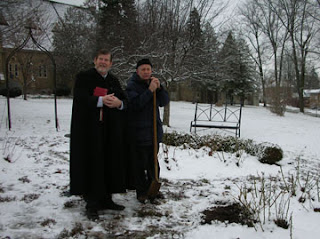
My uncle's ashes were buried in this churchyard on Sunday afternoon.


There were about 300 people in attendance at the church, but only about 50 went to see his ashes buried.


Despite the snow, the ground was not frozen so it was easy for the gravedigger to create and fill the hole.


The graveyard scene was quite Gothic. The church bells were ringing during the ceremony.


His ashes were kept in a wooden box made for my late grandmother by a boyfriend and then poured into a hole in the rose garden.


The rose garden is surrounded by a circular hedge. My uncle's name will be inscribed into a concrete bench encircling part of the garden.

STRATFORD WITHOUT UNCLE WALTER


Arriving at the Stratford, Ont. train station on Saturday, the day before the funeral, was strange. My uncle always met visitors at the station and this time he wasn't there. The last time I visited was in the summer.


My uncle lined up these animal crackers one day to feed to his dog Ruffles.


Then he fed them to her one by one.


My uncle was a very intelligent, kind and generous man. He was a retired school teacher who had taught mainly disabled students. He was involved in a wide variety of community projects. He volunteered at the Stratford Festival by giving backstage and warehouse tours. He delivered meals on wheels. He taught disabled people on a voluntary basis.

He was passionate about Shakespeare and his seasoned criticism of the Stratford Festival productions was very reliable.

He sang in the Stratford Concert Choir and toured and sang at cathedrals in England and Europe with the group.


When I last visited my uncle and aunt in August, I was planning a trip to England. My uncle loved England and taught there in the 1960s. He made many visits over the years--the last one this spring. He showed me the scrapbook he'd put together about his trip and I asked him which place in England was his favourite. He told me it was Exeter. I visited Exeter and its cathedral in October.

When I was there, I took a one-hour guided tour of the cathedral. I chatted with the tour guide and she remembered that the Stratford choir had sung there.

She took me outside to show me the Ontario Heritage Foundation commemorative plaque for John Graves Simcoe, first lieutenant governor of Ontario, after I expressed surprise at seeing a memorial to him inside the cathedral.


Although I didn't see my uncle again after I returned from England, I was able to tell him about my trip during a telephone conversation ~

Jun 6, 2006

Overpriced lodgings in New York City


In my experience, most bed and breakfast owners love to regale their paying guests with long tirades about their travails—business or otherwise—over breakfast.

That’s why I usually avoid B&Bs and stay in hotels when I travel.

My most recent B&B experience occurred in April 2006 when Reuters sent me on an expenses-paid trip to New York City for a week of boot-camp training. I decided to stay four extra days at my own expense. Extending my stay seemed like a good way to maximize the value of a free plane ticket.

It proved more difficult to find affordable accommodations than I expected. I was surprised at how much more expensive New York City has become since I was last there in 1997.

After exhausting the leads on several “cheap hotel-room” websites, a couple of guidebooks and suggestions from friends, I followed up with a couple of B&B organizations.

The cheapest non-B&B alternative I had found was a US$90 per night hotel room in Midtown Manhattan that would require I share the bathroom with the occupants of two other guestrooms. It sounded a little sketchy. Especially after the woman at reception in the hotel said: “I don’t think you want that.”

The B&B I settled on was what turned out to be a fold-out chesterfield in the living room of a one-bedroom apartment in a 1930s apartment building a few blocks from Macy’s for US$110 a night. It was the cheapest one I could find without pets. (See picture above).

There was no door on the room, just a curtain and a screen. The room was done in a very lush Victoriana style with a lot of pink fabric, Turkish carpets, heavy antique furniture and curios.

BOOT CAMP

Reuters booked me into the Club Quarters Hotel on West 45th Street for the training period.

The training consisted mostly of speakers explaining their news beats and practising story writing. The attendees included print and television journalists from other North American Reuters bureaus. We attended a panel talk one evening about news media coverage of Iraq and, on another, a dinner at Trattoria Dopo Teatro on West 44th Street. One evening I went out for a fancy Greek dinner at Avra Estiatorio on East 48th Street with a friend from high school.

FINE ART IN MANHATTAN

The day after boot camp ended, I went to the Guggenheim Museum, which was completely clad in scaffolding as it is undergoing exterior restoration work, and saw the David Smith centennial sculpture retrospective. I liked the Wassily Kandinsky paintings in the permanent collection.

I saw the Edvard Munch exhibit at the Museum of Modern Art. His work is somewhat formless unless the image is graphic. It reminded me a bit of the formlessness of Paul Gauguin’s work, but it’s not nearly as good. The footprint of the MoMA redesign is somewhat confusing. At times it was difficult to find a direct route through the various galleries, which made it hard to know if I’d missed anything.

The biennial at the Whitney Museum of American Art, which I went to after brunch at Vento on Hudson Street, included some interesting work. I went quickly through most of the galleries, but spent a lot of time looking at the Kenneth Anger video and photography.

I especially liked the display of Alexander Calder’s “Circus" (1926-1931) in the Whitney permanent collection. There is an accompanying video loop of Calder playing with the circus characters.

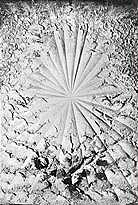
I wanted to see a painting by Jay DeFeo entitled "The Rose" (1959-1966) because I like Bruce Conner's film entitled "The White Rose" (1967) which eulogizes the complicated job of removing the painting from DeFeo's San Francisco apartment to the melancholy tune of Miles Davis' "Sketches of Spain."


The painting, made of lead paint, measures 3.3 by 2.4 metres (11 by 8 feet) and weighs 1,035 kilograms (2,300 pounds).

Last September I went to see it at the San Francisco Museum of Modern Art only to discover that it wasn't there. It is now in the Whitney’s permanent collection. I was surprised that none of the staff on the main floor information desks or in the bookstore knew about it, but even more surprised that none of them looked it up for me. I ended up asking a security guard in one of the galleries who told me it had been on show, but is no longer.

In San Francisco, I saw DeFeo's "Incision" (1958-1961), a bleak oil painting from the same period as "The Rose" measuring approximately 2.7 by 1.2 metres (9 by 4 feet).

TOURING THE CITY

My four-day visit included watching a clown perform in Central Park, wandering on Fifth Avenue and Wall Street, going to the World Trade Center site, Battery Park, Little Italy, Chinatown, Canal Street, Washington Square, Union Square, Soho, Village, Tribeca, Macy’s, Grand Central, United Nations building, Park Slope in Brooklyn, lunches, brunches, dinners and so on.

I was escorted into a black market purse shop on Canal Street. There were lots of Prada and Gucci knock offs. Some men on the street offered to sell me a fake Rolex watch for US$500.

I went on a paid tour of the United Nations building. The U.N. tour guide said that Canadian artist Henry Moore made the bronze sculpture standing outside the building. I did not bother pointing out that Moore is actually from Britain. However, when the tour guide later referred to U.N. troops in Afghanistan I pointed out that those troops are really a U.S.-led Nato force. He acknowledged it is true and then explained the role the U.N. is playing in the region.

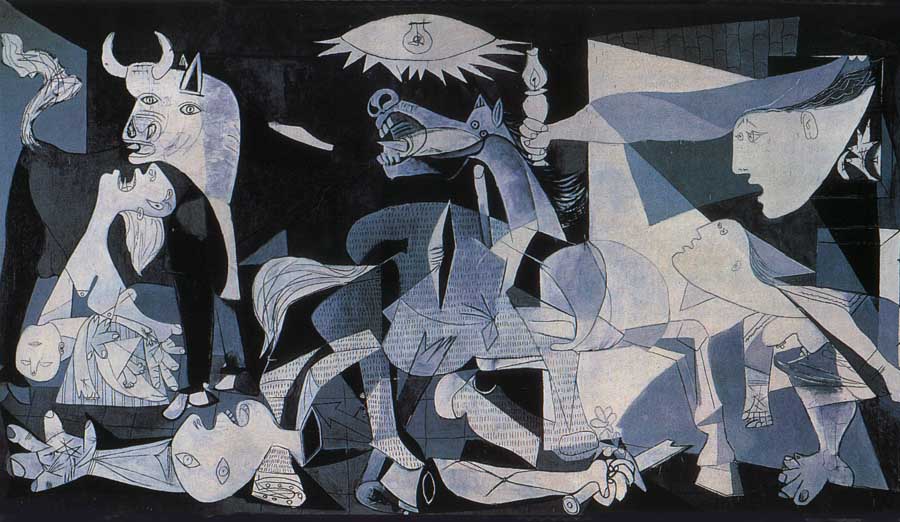
The paid tour did not include a viewing of the tapestry of Picasso’s “Guernica.” I was curious to see it because I saw the 1937 Cubist anti-war painting long ago at a MoMA Picasso exhibit.


The painting depicts the aerial bombing on April 27, 1937 of the Basque city of Guernica by the German Luftwaffe, which killed some 1,600 people during the Spanish Civil War. It was commissioned by the Spanish Republican government for exhibition in the Spanish Pavilion during the Paris International Exposition in 1937 to commemorate the first intentional aerial bombardment of civilians.

The tapestry, which hangs outside the U.N. Security Council, became the centre of a controversy in Feburary 2003 during the lead up to the U.S. war in Iraq. It was concealed from view by a blue cloth and a row of flags when then U.S. Secretary of State Colin Powell presented the U.S. case for war. U.N officials denied charges of a "cover up" when a dispute arose over whether the concealment of the tapestry was politically motivated.

I managed to get in touch with someone in the U.N. building who took me to see the tapestry. He also showed me the delegate’s bar and said it is known as the Star Wars Bar because the delegates wear their national dress when they go for drinks.

I saw only one play—"Rabbit Hole"—recommended by some friends who said it was the best play they’d seen, and they said they’d seen everything. It was good, but not great, not worth US$90 and the theatre was freezing cold. The script was a little weak and wasn’t helped by some not-so-great acting. It’s since been nominated for a Tony Award.

After the play, I went to the Blue Bar in the Algonquin Hotel and watched a diminutive, stooped man billed as the oldest bartender in New York City work while I sipped a US$14 mojito. He's said to be in his 90s. I wanted to go to the Algonquin because I was wearing the pearl necklace of the wife of Canadian Press journalist Al Colletti who was one of my father’s friends. My parents went to his wife’s funeral in New York City some years ago and he gave them her necklace in the Blue Bar. She was cremated and he took her ashes to New Orleans. He hired a jazz band to accompany him as he walked her ashes to the river and threw them in the water. He hadn’t had a drink for 25 years until she died, but afterwards he went to a bar and drank and drank and drank.

THE BED AND BREAKFAST

The B&B I stayed in turned out to be OK, although I was victim to the usual B&B-owner complaints. The host is in her 70s and said she hasn’t worked for more than a year because of ageism.

There were dead cherry blossom boughs in enormous vases in the room.

“Unfortunately, you’ve missed the full bloom of the blossoms,” she said almost wistfully. But I think she may have gotten them out of the trash somewhere. They were a bit of a hazard. I got one of the branches caught in my hair as I walked by and just managed to save the vase and boughs from pitching to the floor.

When prompted, she told some rather horrifying B&B tales. She said she would tell future guests about how I don’t eat eggs or drink coffee. “You certainly burned the candle at both ends,” she said disapprovingly the morning before I left.

That morning there was an insect floating on its back in my orange juice.

I left her a bouquet of bright pink, turquoise and blue daisies and some gourmet jelly beans done up in a bag with real ribbon to try and earn some positive spin in her future tales ~