Showing posts with label war. Show all posts

Oct 20, 2012

Horsham history


I sent this hasty message to my father on Saturday. 

From: Me
To: Dad
Subject: Horsham
Date: Sat, 20 Oct 2012 13:43:28 +0000
En route to Horsham and can't remember what places to look for -- there's the street where the pic is taken and then a pub he went to, but not sure where ...Julie xo

I had decided to go to Horsham in West Sussex to see where my Canadian grandfather, Harry Mollins, was stationed during World War One before being deployed to the battlefields of France, where he fought in the Battle of Vimy Ridge, among others. The weather was very touch-and-go and I didn't get out until quite late in the day, so I decided this would be the day I would go to Horsham.

My father has Harry's war diaries, so we know a fair amount about what he did in Horsham, although he died when my father was 14 -- and long before I was born.

He kept small leather-bound diaries for three years during the war. We don't know what happened to the fourth -- if it was lost or destroyed, but we assume he had kept one because he did so all throughout his life. 

My father transcribed all the diaries and visited Horsham in 2000 with my mother.

My sister summarized my grandfather's Horsham experience on her blog, and I have summarized her summary and posted some of the pictures I took today :)

Harry trained at Roffey just outside Horsham until April 12, 1916. 


He wrote in his diaries about the rain, physical drills, letter-writing and waiting to receive letters, attending church, reading books, and a social life that included teas, theatre, dates, musical evenings, skating and cycling.

This photo is of Harry Mollins (far right), Harry and Fred Fownes (we think) also from his hometown of Moncton, New Brunswick, and an unidentified friend on rented bikes in Horsham.


My father replied to my email:

From: Dad
Sent: Saturday, October 20, 2012 02:27 PM
To: Me 
Subject: RE: Horsham
 
JGM:
The only other thing we can think of was the King's Head Hotel, but your Mum understands that it no longer exists. 
   He took singing lessons nearby and I'll send the teacher's name if I can find it.

   Also this I wrote for a diary report:
    
Before facing those life-threatening actions across the English Channel, Harry spent happier times during recesses from combat training in southeast England and in days off up in London or down in Hastings.

During his training time in southeast England, in a camp on the outskirts of the Sussex County town of Horsham, Harry also spent hours polishing his powerful baritone singing skills. He took lessons from a lady in town.

And on a pass of 12 hours or longer, he occasionally, as his diary puts it: "picked up a girl for the fun of it."  

At times, he would also treat himself in a local hotel. 

[About 80 years later, son Carl and his wife Joan on a trip to Horsham visited that hotel, donated to the owner copies of Dad's diary references to the pleasing place--and that turned out to make our meal free.]


I took the picture above of the King's Head Hotel -- where he stayed -- which is now an Ask Italian restaurant.

My father followed up with a second email:

From: Dad
Sent: Saturday, October 20, 2012 03:09 PM 
To: Me
Subject: RE: Horsham

Also, from your Mum's diary and memory, on our visit in March, 2000, to Horsham we met a citizen living near the place on the road where Dad and pals were photoed on Clarence Road. Mum sez they were interested in the history of their neighbourhood. We gave them copies of the photos. Mum also mentions our interest in pleasant local church, St. Mary's, dating from 1247 -- so now 765 years old.


As well, a theatre where Dad went. now an Arts Centre.


Here is another picture I took:


And apropos of nothing


 It was actually quite a hike around town and out of town to Roffey. I know why they rented bicycles. I managed to catch a bus from Roffey to the Horsham Railway Station. 

From there I took a train bound for London Victoria to Three Bridges and changed to one that would take me to London Blackfriars instead.


Oct 30, 2011

Twitter tales: A love story in 140


The first in a series

It started about a year ago and ended 8 months later.

She got to know him online via Twitter. They connected over war and conflict, a topic of mutual interest.

It later seemed somewhat like a premonition.  

She said she’d like to meet him and he started DMing her in an overtly seductive manner.   

She responded, thinking he was genuinely interested in her.

He told her he had an online girlfriend he’d never met in person. He said he wasn’t interested in having a girlfriend in real life.  

 A contradiction, it’s true.

Sometime later he told her he had split up with his online girlfriend. Things seemed to be swinging in her favour. 

Eventually, they met in person and they had an intimate sexual encounter.

Afterwards, he said he would call her, but he never did.

She hadn’t thought to ask if he was interested in having a regular friendship because she thought they were friends. 

Wrong. 

She was very sad. She felt exploited. 

Alone.  

 She caught up with him on Twitter a few days later and he said he’d been sleeping, that he’d enjoyed the experience they’d had together. 

He had changed.

Things got complicated in the Twitter world. He refused to speak to her on the telephone. She didn’t have his number so she was powerless. 

She then discovered that he was treating other women the same way on Twitter. 

Sadness turned to fear and anger. She felt isolated, vulnerable. 

Trapped by 140, by the world wide web.

She had no one to talk to. 

She looked for help online. 

She needed help. She called a bullying hotline for parents and children. 

They told her to call the police. She did. 

The police officer was kind. Helpful. She felt better.

The officer said all she could do was to warn others.   

She did. He found out. 

Afterwards, he told her he would never speak to her again. 

He hasn’t. 


Apr 5, 2007

Account of the Battle of Vimy Ridge


Easter, 1917
From World War I Pocket Diary
Canadian Artilleryman Harry Whitfield Mollins


Hometown Moncton N.B., served 1915-1918, originally with the 2nd Siege Battery, formed at Charlottetown, P.E.I., later incorporated into the 98th Canadian Siege Battery.

Born November 11, 1895, Melrose, Mass. (In his teens, joined his parents’ return to their original home in Moncton.) Died December 8, 1945, in Toronto.


Thursday, April 5 Weather: Fine
Carrying ammunition to the No. 4 gun all day. We are getting a reserve store ready for the “strafe” which “comes off” in a few days. Aeroplanes very active today.

Good Friday, April 6 Weather: Rain
On duty at the guns all day. Did considerable firing. Mailed letters to Walter Ryder & Grandma and Grandpa Duncan. A “Fritz” plane brought down one of ours, in flames, this evening. He then came right over toward our battery after another, but was driven off by our planes.

Saturday, April 7 Weather: Fine
On ammunition fatigues all day. Did considerable firing. Had to take a count of all the shells et cetera. A “Fritz” plane brought down one of our observation balloons this morning. It came down in flames. Letter from Mrs. Blackmore this evening & Easter cards from Mrs. Morton and Marcella Mollins of Moncton. On the guns all night. Fired 123 rounds.

Easter Sunday, April 8 Weather: Fine
Easter Sunday and a beautiful day. Nothing of importance happened. A few German shells dropped around the position. Our infantry goes over tomorrow in an attempt to capture Vimy Ridge. Expect it will be a big day.

Easter Monday, April 9 Weather: Fine
On fatigues all day. This is the day of the big “strafe.” There was a heavy bombardment at 5:30 a.m. and the infantry went over from Vimy Ridge to the right. Large numbers of prisoners and guns were taken. Vimy Ridge fell into our hands. Parties of prisoners passed our position all day. All seemed glad to have been captured. Our casualties were not very heavy. Nice parcel from mother this evening containing fountain pen, cake, candy, etc.

Tuesday, April 10 Weather: Fine
On the guns all day. Very quiet this morning. We started firing about 11:30 A.M. and from then till six fired 215 rounds. The infantry went over again this afternoon & gained their objective. More prisoners & guns were taken. The reports are very encouraging, in fact, too much so. However, everybody is very happy over the good results. “Fritz” put quite a few shells quite near our position today.
USA has entered the war on the side of the Allies.

Wednesday, April 11 Weather: Rain
On ammunition fatigues today. Had an easy day. “Fritz” shelled quite heavily today. Everything is still going favorably for us. Everyone is jubilant. We expect to be moving forward in a few days. On the guns all night. No firing up till twelve o’clock. Snowing very heavily this evening. “Fritz” shelled in this vicinity.
An ammunition dump of the No. 2 “Heavies” was blown up.

Thursday. April 12 Weather: Snow & Rain
We were called out at 3:30 A.M. and fired twenty rounds. At 5 A.M. there was a twenty minutes “strafe.” It was snowing and blowing something awful & very cold. Our infantry went over & gained their objective, and captured 600 prisoners. Off duty all day. It is reported this evening that 12,000 prisoners have been taken south of Arras, also 400 guns.
USA has declared war on Germany and severed relations with Austria. It is rumored the Argentine & Brazil are at war with Germany & have seized all Hun shipping in their ports.

Friday, April 13 Weather: Fine & warm
Easy day. A very interesting report of operations to date was posted this morning. Wancourt & Heeinel have been captured. The Hindenberg Line has been cleared 2,000 yds. south of Cojeul. The 1st Army (which includes the Canadians) has captured 4,000 prisoners, 33 guns, 112 Machine guns & 40 Trench Mortars. The Third Army on our right has captured 7,526 prisoners, 126 guns, 113 Machine guns, 44 Trench Mortars. The guns captured include 8”, 5.9”, 4.5” & field guns. “Fritz” has retired and our infantry is after him. Got orders to move this evening.


The following morning, the Canadian artillery unit began moving a few kilometres to a battlefront near the villages of Souchez and Carency, where, on Monday, April 16, the Canadian gunners re-engaged German artillery. The diary says:

"While we were firing the Huns burst two shrapnel [shells] right over the gun. No one was hurt. Spent the night in an old cellar, which we cleaned out. We dug up two skeletons in the debris.”

That evening, the diary notes, he received another Easter greeting card from home. It was to be almost 19 months before the war ended—on Harry Mollins’s 23rd birthday.


------------

Back home in Moncton, he worked for a time as manager of the furniture section of the local Eaton’s department store and polished his reputation as a baritone soloist in the city’s Baptist church and other choirs.

In the 1920s, he married Vera Grace Nickerson, gained B.A. and B.D. degrees at Acadia University in Wolfville, N.S., and became minister of the Baptist church in nearby Windsor, N.S.

He later served ministries in Ottawa (Fourth Avenue Baptist Church, 1933-1939) and in Brantford, Ont. (Park Baptist Church, 1939-1945, where his first sermon was given on the first day of World War II, Sunday, September 3, 1939) before the final 10 weeks of his life in Toronto (College Street Baptist Church) after the end of World War II.

Compiled by Carl Mollins, son of Harry, 5-4-07

Aug 29, 2006

Stewing over Canadian cooking


My mother is renowned for her creative cooking. This year, during the dog days of summer, she served up a spectacular two-layer blueberry-raspberry shortcake.

I wondered how a British-born-and-bred woman came to make shortcake of any kind, let alone such a splendid variation on the classic North American strawberry dessert.

I asked her if it was a dessert she had made in England before she migrated to Canada in the 1960s.

“I didn’t make it in England because I’d never heard of it,” she explained. “The first time I had it was at a party in Toronto.”

PROFESSIONAL LIFE

My mother moved to London by herself from a small village at the age of 14 during the Second World War. She worked as a nanny and then became a cook.


She looked after a boy in Chepstow Villas in Notting Hill for several years, but one of her most memorable employers was Bill Linnet, a theatre producer who lived in Westminster behind the Abbey. He always ensured that she and her friends got tickets to see the plays he produced in the West End. His chauffeur taught her to drive.

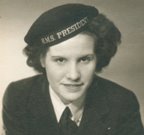
She joined the Women's Royal Naval Service to become a Wren because she wanted to learn to drive a truck. She was trained in Reading and then--the same day the Queen was married on November 20, 1947--she was sent to Greenwich where she was stationed as an officer's steward.


She met my Canadian-born father in London in the mid-1950s when he was working as a journalist on the old Nordesk for Reuters on Fleet Street.

He had lived in a house in Bayswater where she lived and went to collect his mail. He invited her out.

She first moved to Canada some years after she married him. Before she moved to Toronto they socialized with his Canadian friends and colleagues in London.

"Canadians in London went on about the awful food in Britain," she said, which led her to expect excellent cuisine in Canada. She was sorely disappointed.

INTRODUCTION TO CANADIAN FOOD

The first Canadian food she ate was a sandwich she bought on the train from Montreal to Toronto after disembarking from the Italian-owned ship, the Homeric, which had a Greek crew.

“It was revolting,” she said. “I had a roast beef sandwich because everyone had gone on about it, and it stuck to the roof of my mouth.”

She described the party she attended upon her arrival in Toronto where she first ate strawberry shortcake as typically “suburban Canadian.”

“It was the worst night of my life,” she said. “I walked in and there were about 50—all blond—women.”

The dessert was a frozen pound cake with frozen crushed strawberries and fake whipping cream on it.

FAMILY

My mother grew up in a village in the south of England during the Great Depression.


My grandmother worked as a cook in big houses. One of them was called Hillview. It was owned by Cecil Wray, the former governor of the Malay States. The Wrays had made their fortune from rubber in Malay and Kenya.

She worked also for the Ash family who made their money from the cotton industry in Manchester.


My grandfather served in the Royal Navy on HMS Barham and fought in the 1916 Battle of Jutland in the First World War.


He became a gardener after he was forced to retire from service in 1936 after 24-and-a-half years because of a serious knee injury. He had signed up for 25 years of service at 17.


My mother's brother, my uncle, who was 10 years older than her, served on a tank crew in the British eighth army and fought in the North African and Italian campaigns of the Second World War. After the war he worked for the post office and played accordion in a band.


LIVING WITH RATIONS

Food was rationed during and after the war. Meat, butter and eggs were rationed. Everyone grew his or her own vegetables.

“Our Sunday joint was just a few ounces,” my mother said.

My grandparents kept chickens and rabbits. People in the village registered with them to get rationed eisenglass eggs, which were a type of pickled egg. When the chickens got too old to lay eggs they were used for eating.

My grandfather had a goose named Pickles that was given to him by Commander Wrightson, a man for whom he worked at Dower House.

Wrightson helped him get a decent pension from the Navy.

"People shared food," my mother said. "If there were a lot of eggs, people got lots of eggs."

One of their neighbours in the village had throat cancer and everyone gave him bananas when they got them because he couldn’t eat much. They didn’t get much fruit.

My grandmother made dandelion wine and cheese.

Although the war ended in 1945, it wasn’t until the Queen’s coronation in 1953 that rations came off candy.

ADJUSTING TO CANADA

My mother hated Toronto the first time she lived there, but my paternal grandmother, with whom she and my father lived, was very empathetic.


My mother said it was because my grandmother, who was originally from Shediac, New Brunswick and married a Baptist minister, understood what it was like to relocate with children. She lived in several places in the Maritimes and Ontario with my grandfather who served at five different churches in five different cities during his lifetime.


“She came from the Maritimes to Ottawa and it was a big shock to the system,” my mother said. “She left her family behind.”

As to why she started making strawberry shortcake, my mother said: “I don’t know why I made it, it was something all Canadians had. “ ~

OTHER CREATIONS